

Buying a Home From a Power of Attorney Seller: What the Disclosure Won't Tell You
Does buying a home sold under power of attorney change anything for the buyer? Not the legal ground rules — Oregon's disclosure law still applies — but it can change where you focus your due diligence, from inspections to your rate lock timeline.
You're Not the One Managing the Paperwork — But It Still Affects You
If your agent has flagged that a home you're interested in is being sold under power of attorney, it likely came from one of two places: a note in the MLS agent-only remarks, or a conversation your agent had with the listing agent before you wrote an offer — something a good buyer's agent asks about routinely. Either way, you're going in with a fair question: does this change anything for me?
The honest answer is a little of both. On the seller's side, there's a specific set of paperwork requirements they need to have in order — we've walked through those in detail in our guide to selling a parent's home under power of attorney, if you want the full picture of what's happening behind the scenes. But you're not the one managing that. You're the one deciding whether to write an offer, how to structure it, and what to do if the disclosure statement looks a little thinner than you're used to seeing.
It's a scenario we see fairly often across Canby, Oregon City, Wilsonville, and the surrounding Willamette Valley, where a good number of sellers are adult children or trusted family friends managing a sale for an aging parent. The legal ground rules don't change much, but a POA sale can change what a smart buyer pays attention to. Here's what that looks like from your side of the transaction.
What More "Unknown" Answers Should Change About Your Offer, Not Your Comfort Level
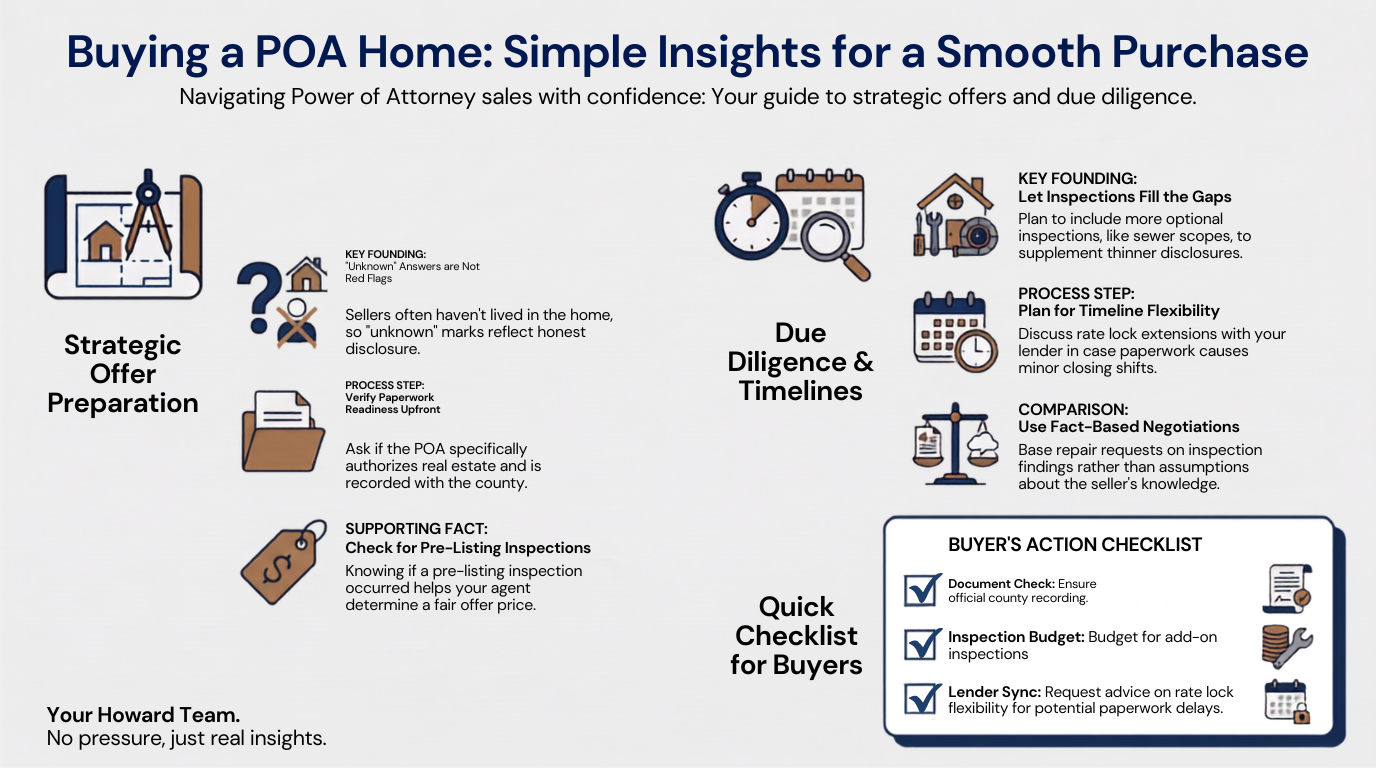
You may notice a POA disclosure has more "Unknown" marks than a typical resale. That's expected, not a warning sign — the person signing often didn't live in the home day to day, so they're answering honestly about what they don't know firsthand. It's not something to take personally or read into.
But "not a red flag" doesn't mean "no different than any other disclosure." It just means the response belongs in your offer strategy, not your gut reaction.
In practice, that usually means leaning a little harder on your inspection once you're under contract. A thinner disclosure is exactly what a home inspection is designed to fill in — so if you were on the fence about which optional inspections to include (sewer scope, roof certification, that kind of thing), a POA sale is a reasonable nudge toward including more of them rather than fewer. Worth knowing upfront: that can chip into your budget a bit more than you'd planned, since those add-ons come out of pocket before you know whether they'll turn anything up. It's a worthwhile trade-off for the added information, but it's fair to plan for it rather than be surprised by it.
The goal isn't to treat the seller with suspicion. It's to let your own due diligence do the work the disclosure couldn't.
What Your Agent Should Confirm Before You Write an Offer
Once your agent knows a sale involves power of attorney, there are a couple of quick questions worth putting to the listing agent before you move forward with an offer — not because you're managing the paperwork, but because the answers affect how confidently you can rely on the timeline you're working toward.
The two that matter most: does the power of attorney document specifically authorize real estate transactions, and has it already been recorded with the county? These aren't unusual questions, and a listing agent handling a POA sale properly will have straightforward answers ready. If the document hasn't been recorded yet, that's not necessarily a problem — but it's better to know going in than to find out mid-transaction.
It's also worth asking whether there was a pre-listing inspection. Buyers don't always see the property disclosure before an offer is accepted, but if the seller's side is willing to share it early, that disclosure will typically answer the inspection question directly. If it's not available yet, simply asking the listing agent is a reasonable fallback; a straightforward "was there a pre-listing inspection" question rarely goes unanswered.
Knowing the answer matters for more than curiosity. If a pre-listing inspection happened, it means the seller already has a clear picture of the home's condition — and there's a good chance the list price reflects that. That's useful context for your own agent when it's time to land on an offer price, since it can point toward how much room, if any, there might be to negotiate.
This is a quick check, not a deep dive. You're not verifying legal paperwork yourself; you're making sure the pieces that could affect your closing date, and your own offer strategy, are already accounted for on the other side.
What Happens to Your Timeline If Something's Not in Order
Most POA sales close on a normal timeline. When they don't, it's almost always because of something in the paperwork — usually a POA document that hasn't been recorded yet, or one that needs a closer look from the title company before it clears. If your agent asked the right questions upfront, this is rarely a surprise. But it's worth knowing what a delay would actually mean for you, since the seller's paperwork issue becomes your timeline problem.
The most common ripple effect is on your rate lock. If closing pushes back a week or two while the title company sorts out documentation, you may need to extend your lock — sometimes at a cost, depending on your lender. This is worth raising with your lender directly, and early. Once you know a sale involves power of attorney, it's a good idea for you, your agent, or both to have a quick conversation with your loan officer about the situation and get their best advice on how to structure your lock, since lenders vary in how they handle extensions and what they'll recommend given a bit of advance notice. If you're coordinating a move, a lease end date, or the sale of your own home, it's worth building in a little flexibility rather than planning around the tightest possible closing date.
None of this means you should expect delays on a POA sale. Most move through without any extra friction. It's simply a good reason to ask the questions in the section above before you're under contract, rather than after.
When to Ask for More — and How to Ask
If your inspection turns up something the disclosure didn't address, that's not unusual for a POA sale, and it doesn't call for a different approach than any other transaction. You still have the same tools available: requesting a credit, asking the seller to address a specific repair, or adjusting your offer if something significant comes up. What's different is simply the framing your agent might use.
Since the seller's side has already been upfront that their knowledge has limits, a straightforward, fact-based ask tends to land well: "The inspection found X — given that this wasn't something the disclosure could speak to, we'd like to talk through a credit or repair." That's a request grounded in what the inspection actually found, not a suggestion that anything was hidden. Sellers and their agents in these situations are usually receptive to that kind of conversation, because it's the exact reason the extra inspection budget exists in the first place.
The bottom line: a POA sale doesn't limit your options at the negotiating table. It just means your leverage tends to come from what your inspection uncovers, rather than from the disclosure alone.
Frequently Asked Questions
Does a power of attorney affect whether a disclosure statement is required?
No. Oregon still requires a property disclosure statement in a POA sale — that exclusion only applies when a court-appointed personal representative is settling an estate. As a buyer, you should still expect to receive one; it just may include more "Unknown" answers than usual.
Will the buyer have any direct contact with the homeowner during a POA sale?
Typically, no — and that's true of most transactions, not just POA sales. Your agent communicates with the listing agent, who communicates with the POA holder, keeping the same arm's-length structure in place that protects everyone in a standard sale. A POA sale doesn't change that dynamic.
Does it matter if the power of attorney holder isn't a family member?
Not from a buyer's standpoint. Whether the POA holder is an adult child, another relative, or a trusted professional the homeowner named, the legal requirements — proper authorization, recording, and disclosure — stay the same either way.
Does a POA sale take longer to close than a typical resale?
Not usually. Most move through on a normal timeline. Delays, when they happen, tend to trace back to POA documentation that hasn't been recorded yet — which is exactly why it's worth confirming early.
Reach out for a local snapshot — no pressure, just real insights.
Ruth & Frank Howard, Brokers | Your Howard Team | Equity Oregon Real Estate
Serving Canby, Oregon City, Wilsonville, Woodburn, Aurora, Hubbard, and surrounding Willamette Valley communities.
Local market knowledge across the Willamette Valley — from Canby and Oregon City to Salem, Keizer, Woodburn, Hubbard, and surrounding areas.
 All information provided is deemed reliable but is not guaranteed and should be independently verified. IDX information is provided exclusively for consumers' personal, non-commercial use, that it may not be used for any purpose other than to identify prospective properties consumers may be interested in purchasing, and that the data is deemed reliable but is not guaranteed accurate by RMLSTM.
The content relating to real estate for sale on this web site comes in part from the IDX program of the RMLSTM of Portland, Oregon. Real estate listings held by brokerage firms other than Equity Oregon Real Estate are marked with the RMLSTM logo, and detailed information about these properties includes the names of the listing brokers. Listing content is copyright © 2026 RMLSTM, Portland, Oregon.
This content last updated on September 21, 2026 1:28 PM UTC at 4 AM. Some properties which appear for sale on this web site may subsequently have sold or may no longer be available.
All information provided is deemed reliable but is not guaranteed and should be independently verified. IDX information is provided exclusively for consumers' personal, non-commercial use, that it may not be used for any purpose other than to identify prospective properties consumers may be interested in purchasing, and that the data is deemed reliable but is not guaranteed accurate by RMLSTM.
The content relating to real estate for sale on this web site comes in part from the IDX program of the RMLSTM of Portland, Oregon. Real estate listings held by brokerage firms other than Equity Oregon Real Estate are marked with the RMLSTM logo, and detailed information about these properties includes the names of the listing brokers. Listing content is copyright © 2026 RMLSTM, Portland, Oregon.
This content last updated on September 21, 2026 1:28 PM UTC at 4 AM. Some properties which appear for sale on this web site may subsequently have sold or may no longer be available.
