

How do you help a parent sell their home without creating more stress for everyone involved?
Start with a realistic timeline, a trusted local team, and the understanding that this sale is not like any other — it's personal, logistically complex, and worth doing at the right pace.
There's a moment many adult children recognize. You're sitting in your parent's living room — the one where holidays happened, where kids grew up, where decades of ordinary life accumulated — and you realize the house has become more than they can manage. The yard isn't getting done. The stairs are getting harder. The space that once felt full of life now feels heavy.
You want to help. But where do you even start?
Selling a parent's home is one of the most emotionally loaded real estate transactions a family can navigate. Nationally, Baby Boomers now make up 53 percent of all home sellers, according to the National Association of Realtors' 2025 Profile of Home Buyers and Sellers — and the most common reasons they're selling are that their homes have grown too large or they want to be closer to family. Here in Oregon, that wave is especially visible: nearly one in five state residents is now 65 or older, and homeownership among Oregonians in that age group peaks at around 80 percent. That's an enormous number of families who will navigate this transition in the years ahead — and many already are.
The families who come through this process with the least regret are almost always the ones who gave themselves permission to take it one step at a time.
Why This Sale Is Different From Any Other
Most home sales are transactional. A seller decides to move, prices the home, and works through the logistics. The timeline is driven by the market and the seller's next chapter.
When a parent is involved, the picture changes. The seller may not have chosen this transition — health, finances, or family circumstances may have made the decision for them. There may be grief attached to leaving, even when the move is clearly the right one. And the adult child coordinating everything is often doing so while also managing their own job, family, and the emotional weight of watching a parent's life shift.
Add decades of accumulated belongings, a home that may need updating, and vendors who need to be scheduled weeks in advance — and you have a process that simply cannot be compressed into a few weeks without something going wrong.
The Biggest Mistake Adult Children Make: Moving Too Fast
The most common regret we hear from families isn't that the process took too long. It's that they rushed.
Rushing usually looks like one of a few things: listing the home before it's ready and watching it sit, accepting a cash investor's offer out of exhaustion without knowing what the home was actually worth, or pushing a parent through the emotional and logistical work of clearing out a lifetime of belongings on someone else's schedule.
None of those outcomes serve the seller — or the adult child who wanted to do right by them.
A good agent who understands senior transitions will tell you the same thing: there is almost always time to do this right. The goal is the best outcome for your parent, not the fastest close.
Building a Realistic Timeline
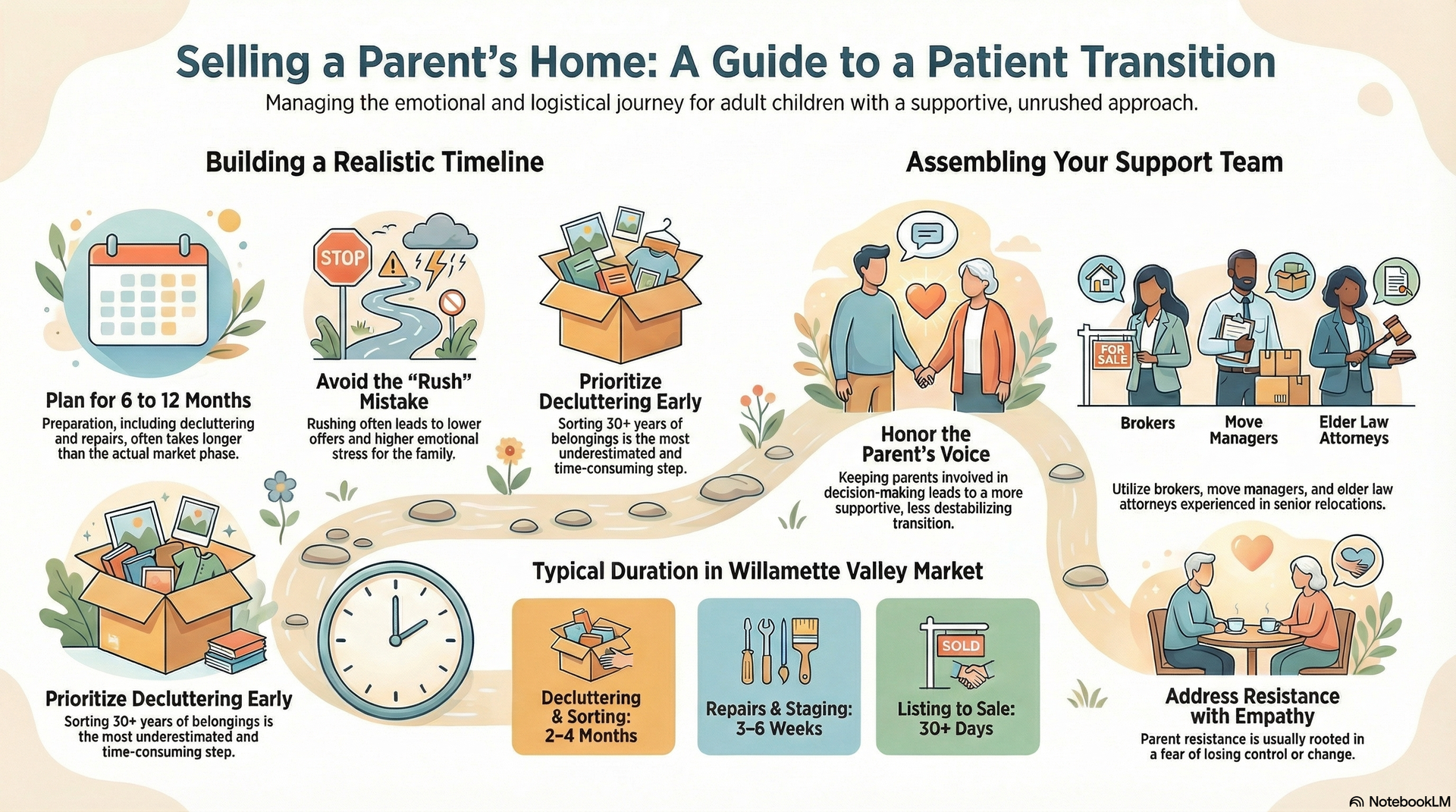
One of the most useful things you can do early in the process is build a realistic picture of how long each piece actually takes. Here's what families in the Willamette Valley are typically looking at:
Decluttering and clearing the home: This is almost always the longest step, and the most underestimated. For a home where someone has lived for 20 or 30 years, a realistic timeline is two to four months at minimum — and for many families, the full preparation phase takes six months to a year, particularly when a parent is involved in sorting and decision-making. Rushing this step rarely saves time overall. For a practical room-by-room system to work through this process, we put together a step-by-step clearout guide specifically for downsizers and their families.
Repairs and updates: Minor cosmetic work can move quickly. Anything requiring a licensed contractor — electrical, plumbing, roofing — depends on vendor availability. In the Canby and surrounding Willamette Valley area, contractors are busy. Families who don't have existing relationships can wait several weeks just to get a bid.
Staging and photography: Once the home is cleared and any repairs are complete, professional staging and photos typically take one to two weeks to coordinate.
Listing and sale: Once the home hits the market, sellers in today's more balanced Willamette Valley market should plan for additional time. Homes are sitting longer than they did even a year ago, and the first two to three weeks remain the most critical window for generating strong offers — but a sale in 30 days is no longer the norm. Budget realistically, and don't let a slower pace pressure you into accepting terms that don't serve your parent.
One important note on the overall preparation timeline: the steps above can easily take six months to a year on their own, especially when a parent is involved in the sorting and decision-making. For many families we work with, the preparation phase takes just as long as the market phase, sometimes longer. Building that time into your expectations from the start makes the whole process feel less like a race.
Who Should Be Involved — and When
One of the advantages of working with an agent who has deep roots in senior transitions is access to a trusted network of professionals who specialize in exactly this kind of move.
The team for a parent's home sale typically includes:
- A real estate broker experienced in senior transitions, staging, and Willamette Valley market conditions
- An estate sale planner, if the home has significant contents to liquidate
- A senior move manager or professional organizer, to help with the emotional and logistical work of sorting decades of belongings
- A licensed contractor, for any repairs needed before listing
- A probate or elder law attorney, if questions about legal authority, estate planning, or decision-making capacity are part of the picture
Getting these people involved early — before you're in a rush — makes an enormous difference. The families who struggle most are often the ones who waited until everything felt urgent before reaching out for help.
How to Honor Your Parent's Role in the Process
This piece is easy to overlook when you're in coordination mode, but it matters more than almost anything else.
Most families want their parent to feel respected and included throughout this process — and even small gestures go a long way. Being involved in choosing what stays and what goes, having a say in the timing, or simply being kept informed at each step can make an enormous difference in how the transition feels for everyone.
Ruth and Frank Howard spent years working alongside families at a local retirement community — managing resident transitions, working with adult children navigating a parent's move, and learning firsthand what makes this process feel supportive rather than destabilizing. The single most consistent thing they observed: when a parent feels heard and respected throughout the process, the entire family comes through it better.
That doesn't mean letting hesitation stall the sale indefinitely. It means building a process that keeps the parent in the conversation, sets honest expectations, and moves at a pace that allows everyone to adjust.
Frequently Asked Questions
How long does it typically take to sell a parent's home from start to finish?
The honest answer: longer than most families expect. Clearing the home, handling repairs, and preparing it for market can take six months to a year — particularly when a parent is part of the process and decisions need to be made thoughtfully rather than quickly. Once the home is listed, today's more balanced market means additional time on market is common. Build a generous timeline from the start and treat any extra time as a feature, not a delay.
What if my parent is resistant to selling?
Resistance is common and usually rooted in fear — of loss, of change, of losing control. Involving them in the process rather than driving it for them, and working with an agent who understands senior transitions, can help. In some cases, a geriatric care manager or family counselor is a valuable addition to the team. The goal is never to override your parent's feelings, but to help them make a decision they can feel good about.
Do I need power of attorney to help sell my parent's home?
This is an important question that goes beyond real estate — it touches on legal and financial decisions specific to your family's situation. We'd encourage you to speak with a qualified attorney, such as a probate or elder law attorney, who can advise you based on your parent's circumstances. What we can tell you from experience is that families who have these conversations early — before a health change or urgency sets in — tend to navigate the process with far less stress.
Your Howard Team — Ruth and Frank Howard, Brokers with Equity Oregon Real Estate — works with families across the Willamette Valley who are navigating exactly this kind of transition. From Canby and Oregon City to Salem, Keizer, Woodburn, Hubbard, and surrounding communities, we bring local market knowledge, a trusted vendor network, and the kind of firsthand experience with senior moves that most agents simply don't have.
Reach out for a local snapshot — no pressure, just real insights.
 All information provided is deemed reliable but is not guaranteed and should be independently verified. IDX information is provided exclusively for consumers' personal, non-commercial use, that it may not be used for any purpose other than to identify prospective properties consumers may be interested in purchasing, and that the data is deemed reliable but is not guaranteed accurate by RMLSTM.
The content relating to real estate for sale on this web site comes in part from the IDX program of the RMLSTM of Portland, Oregon. Real estate listings held by brokerage firms other than Equity Oregon Real Estate are marked with the RMLSTM logo, and detailed information about these properties includes the names of the listing brokers. Listing content is copyright © 2026 RMLSTM, Portland, Oregon.
This content last updated on September 21, 2026 1:28 PM UTC at 4 AM. Some properties which appear for sale on this web site may subsequently have sold or may no longer be available.
All information provided is deemed reliable but is not guaranteed and should be independently verified. IDX information is provided exclusively for consumers' personal, non-commercial use, that it may not be used for any purpose other than to identify prospective properties consumers may be interested in purchasing, and that the data is deemed reliable but is not guaranteed accurate by RMLSTM.
The content relating to real estate for sale on this web site comes in part from the IDX program of the RMLSTM of Portland, Oregon. Real estate listings held by brokerage firms other than Equity Oregon Real Estate are marked with the RMLSTM logo, and detailed information about these properties includes the names of the listing brokers. Listing content is copyright © 2026 RMLSTM, Portland, Oregon.
This content last updated on September 21, 2026 1:28 PM UTC at 4 AM. Some properties which appear for sale on this web site may subsequently have sold or may no longer be available.
