


Should you lower your list price for a known repair, or list at market value and negotiate after inspection? Either approach can work in the Willamette Valley — the right one depends on where your home's condition places it within your CMA's pricing range, and how much negotiating leverage buyers currently have in your city and price tier.
You're sitting with the disclosure form in front of you, working through the questions line by line. Has the roof ever leaked, and if so, was it repaired? Is the water heater in good working order? There's no line that asks how old something is — the form asks about function and history, not age. And for anything that doesn't have its own dedicated question, like a fence that's seen better days, there's a catch-all near the end: are there any other material defects affecting the property or its value that a buyer should know about. That's where things like this usually end up. You know it needs an honest answer. What you don't know is whether it should also come off your asking price.
This is one of the most common calls we get from sellers once a pre-listing inspection or disclosure statement is in hand. There's no universal right answer, but there is a way to think it through clearly — and it matters just as much on the buyer's side of the transaction, where a good agent knows how disclosure actually works before advising a client.
Two Paths, Same Problem
When we run a CMA, comparable sales give us a range — the top of that range reflects a home in exceptional condition. From there, we weigh what we actually know about the seller's home and land on a recommended list price within that range. Every home carries some repair needs; the real question isn't "perfect vs. flawed," it's where a specific home honestly sits.
Once you know that, you're choosing between two approaches: reflect known conditions in where you land within the range now, or price closer to the top and let buyers respond to what's disclosed once they're interested.

Oregon Disclosure Rules Make This Decision Different
Whichever path you choose, disclosure isn't optional. Unless the property is exempt, Oregon law requires sellers to complete and deliver a Seller's Property Disclosure Statement to any buyer who submits a written offer. Pricing in a known issue doesn't reduce what you're required to disclose, and disclosing an issue doesn't obligate you to lower your price — the two are separate decisions that happen to intersect on the same form.
When Pricing In Makes Sense
Larger, well-documented issues — a roof nearing the end of its life, an aging HVAC system, a known structural concern — are things a buyer's own inspector will likely catch regardless. Pricing these in by landing lower within your range lets you control the framing instead of reacting to a repair request after you're already under contract.
When Waiting for Negotiation Makes Sense
Cosmetic issues, or anything where the true repair cost is genuinely uncertain, often make more sense to handle through negotiation. Pricing closer to the top of your range keeps you visible in the price ranges buyers are searching, and it leaves the repair conversation for after inspection, when the actual scope and cost are better known to everyone involved.
When Disclosures Get Shared With an Interested Buyer's Agent
Full disclosure isn't optional — it's for the seller's own protection, and we advise every seller clearly on it. Oregon law doesn't allow us to fill out a seller's disclosure statement on their behalf; that's the seller's own account of the property. What we do is advise sellers on what the law requires and what their obligations are, so they can complete it accurately and protect themselves in the process.
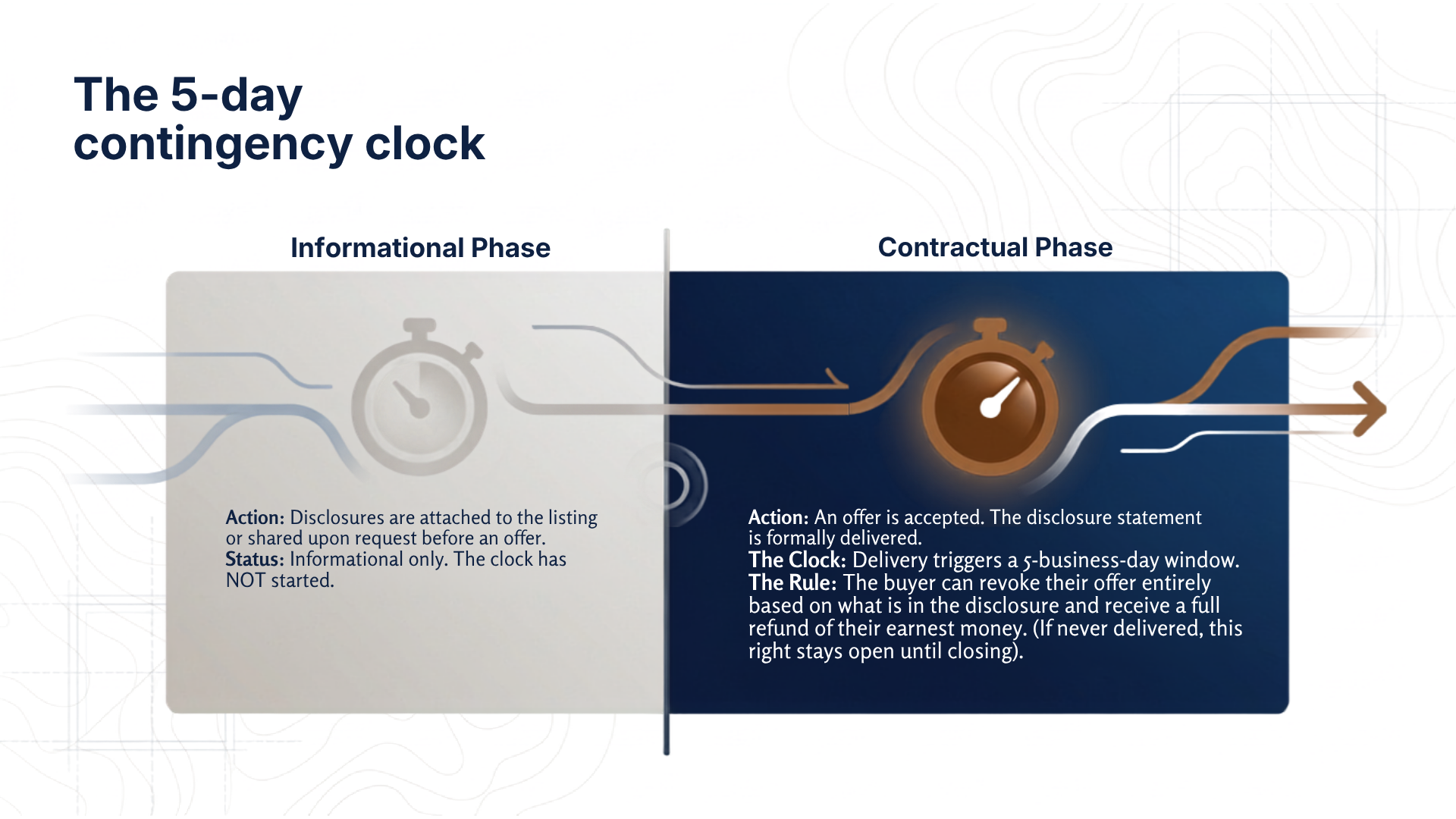
What varies is when an interested buyer's agent will actually see it. Oregon's standard practice ties disclosure to a built-in property disclosure contingency: once an offer is accepted, delivery of the disclosure statement starts a five-business-day window for the buyer to revoke the offer entirely based on what's in it. When a home has more significant known conditions — especially something that surfaced in a recent inspection and shows up on the disclosure statement — we talk through two options with the seller. One is attaching the disclosure statement directly to the listing, so any agent considering the home can review it before ever scheduling a showing. The other is keeping disclosures off the listing but making them available on request, once a buyer's agent has genuine interest. Either way, this early access is for informational purposes only — it doesn't start the revocation contingency clock. That clock only begins once the parties are under contract and the disclosure is formally delivered in response to an accepted offer. What early access does is let a buyer's agent talk it through with their client and decide whether the home is worth touring or offering on in the first place, which cuts down on showings that were never going anywhere and takes some pressure off the seller.
For homes in good condition, where repairs fall in a normal, expected range, we typically don't attach disclosures to the listing. If a buyer's agent asks and we have the seller's permission, we always provide them.
If you're the buyer's agent and a specific condition question matters to your client, it's worth simply asking the listing agent whether disclosures are available for review. Sometimes they're already attached. Sometimes it's a quick request away.
How This Plays Out in the Willamette Valley Right Now
Negotiating room varies by city and price tier across our territory right now, which we walked through in more detail in our recent post on negotiation dynamics. The same is true here — how much flexibility a known repair buys you in negotiation depends on where the home sits and what else is competing for the same buyer.
FAQ
Do I have to disclose a repair even if I lower my price for it?
Yes. Oregon's disclosure requirement applies regardless of pricing strategy — a lower price doesn't substitute for disclosing a known material defect.
How much should I take off the price for a known repair?
Start with where your home falls within your CMA's range — from typical condition up to exceptional condition — based on what you and your agent actually know about the home. That range, not a flat dollar formula, is the more accurate starting point.
Can a buyer still ask for repairs if I already priced in a known issue?
Generally, yes — pricing lower within your range doesn't waive a buyer's right to request repairs or additional concessions after inspection, though it does give you a stronger position to point to when responding.
What is the property disclosure contingency in Oregon?
Once a buyer's offer is accepted, delivery of the seller's disclosure statement starts a five-business-day window during which the buyer can revoke the offer entirely, for any reason tied to what's disclosed, and receive a full refund of earnest money. If a seller never delivers a disclosure, that right stays open until closing.
Reach out for a local snapshot — no pressure, just real insights.
Ruth & Frank Howard, Brokers | Your Howard Team | Equity Oregon Real Estate
Serving Canby, Oregon City, Wilsonville, Woodburn, Aurora, Hubbard, and surrounding Willamette Valley communities.
Local market knowledge across the Willamette Valley — from Canby and Oregon City to Salem, Keizer, Woodburn, Hubbard, and surrounding areas.
 All information provided is deemed reliable but is not guaranteed and should be independently verified. IDX information is provided exclusively for consumers' personal, non-commercial use, that it may not be used for any purpose other than to identify prospective properties consumers may be interested in purchasing, and that the data is deemed reliable but is not guaranteed accurate by RMLSTM.
The content relating to real estate for sale on this web site comes in part from the IDX program of the RMLSTM of Portland, Oregon. Real estate listings held by brokerage firms other than Equity Oregon Real Estate are marked with the RMLSTM logo, and detailed information about these properties includes the names of the listing brokers. Listing content is copyright © 2026 RMLSTM, Portland, Oregon.
This content last updated on September 21, 2026 1:28 PM UTC at 4 AM. Some properties which appear for sale on this web site may subsequently have sold or may no longer be available.
All information provided is deemed reliable but is not guaranteed and should be independently verified. IDX information is provided exclusively for consumers' personal, non-commercial use, that it may not be used for any purpose other than to identify prospective properties consumers may be interested in purchasing, and that the data is deemed reliable but is not guaranteed accurate by RMLSTM.
The content relating to real estate for sale on this web site comes in part from the IDX program of the RMLSTM of Portland, Oregon. Real estate listings held by brokerage firms other than Equity Oregon Real Estate are marked with the RMLSTM logo, and detailed information about these properties includes the names of the listing brokers. Listing content is copyright © 2026 RMLSTM, Portland, Oregon.
This content last updated on September 21, 2026 1:28 PM UTC at 4 AM. Some properties which appear for sale on this web site may subsequently have sold or may no longer be available.
