


Selling a parent's home under power of attorney in Oregon still requires a property disclosure statement — that exclusion only applies to a court-appointed personal representative settling an estate, not to a POA holder. If you're navigating that side of things instead, our guide on "What to Expect When Selling an Inherited Home in Oregon" walks through what changes. In practice, a POA sale usually means answering many disclosure questions honestly as "Unknown," which is expected, not a red flag.
We work with power of attorney sales regularly, and families are often surprised by how little actually changes on the transaction side. But we've also sat across the table enough times to know that doesn't mean it feels simple. If you hold power of attorney, you're likely carrying decisions no one prepared you for — managing a parent's care, other family members' expectations, and the emotional weight of the sale, often all at once.
Power of attorney isn't always a son or daughter, either. We've worked with nieces, nephews, longtime friends, and professionals a parent trusted enough to name. Whoever you are in this process, here's what we actually see on our end, so you know what to expect going in.
What We Ask For Before We List a POA Sale
Once we know a sale involves power of attorney, a few things move to the front of the process.
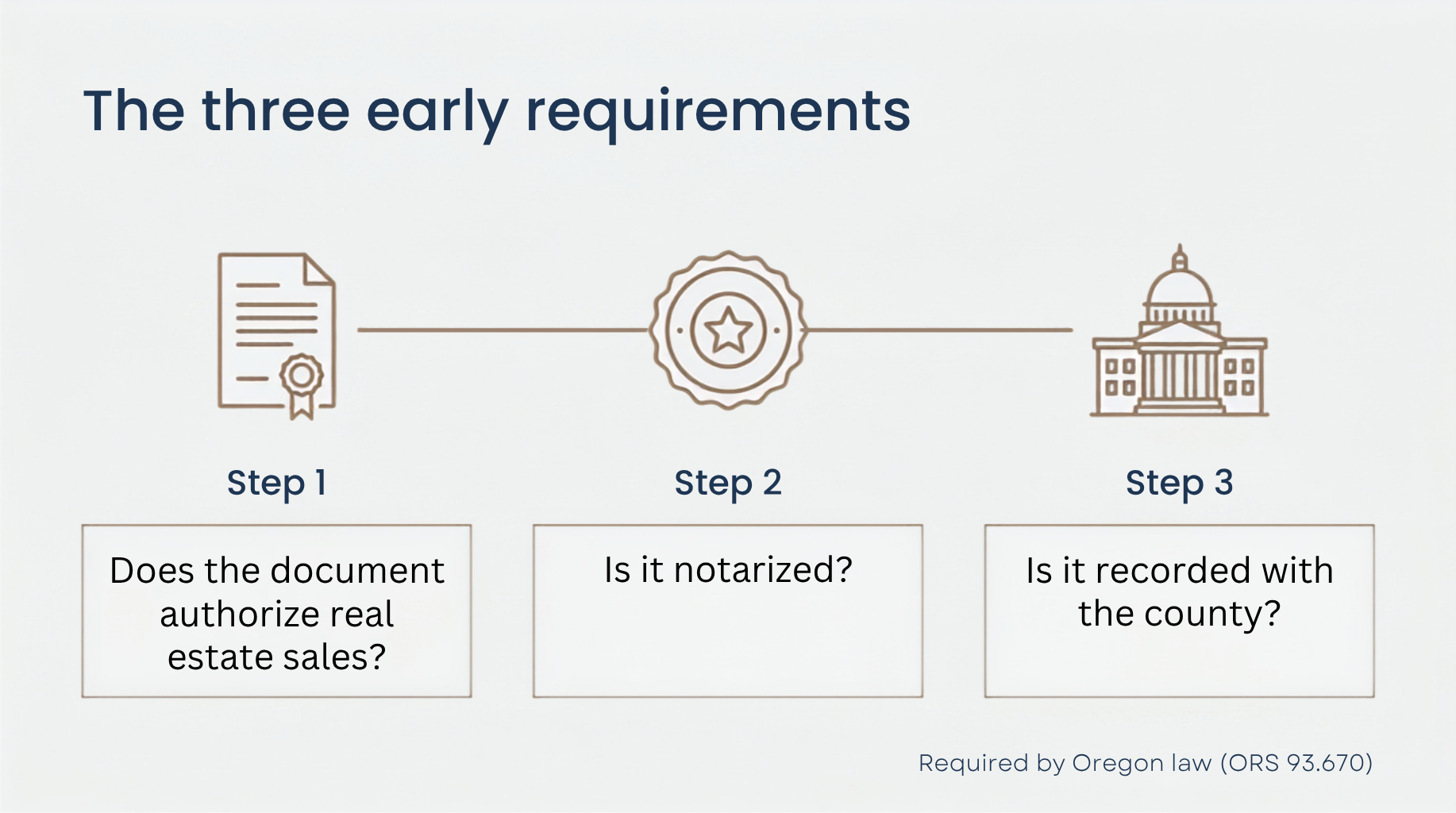
First, we want to see the POA document itself, specifically to confirm it authorizes real estate transactions. Not every power of attorney does — some are limited to financial or medical decisions and don't cover selling property.
Second, under Oregon law (ORS 93.670), a POA used to convey real estate needs to be notarized before it can be recorded with the county, and title companies rely on that recording to move forward with a closing. If your parent's POA hasn't been recorded yet, we'll flag that early so it's handled well before closing day.
Third, we talk through who will actually be signing what, and when. It's a small thing, but it saves confusion once offers start coming in.
Completing the Disclosure Statement When You're Selling for a Parent
This is the part that surprises people most. Since power of attorney doesn't carry the disclosure exclusion, Oregon still requires the property disclosure statement to be completed.
Oregon law doesn't allow us to fill out or manage this form on your behalf — it has to reflect what you actually know. What we can do is help you think through it carefully, so your answers are as accurate as possible. If your parent is still able to answer questions about the home's condition, we'll often talk through it with you both together. If they're not, because of health, memory, or simply not having lived there recently, you complete the form based on your own actual knowledge, which is what the law asks for. That often means marking "Unknown" on questions about things like past repairs or the home's history, and that's expected.
That's not a problem to hide from buyers. It's an honest answer, and buyers working with an experienced agent understand it. What we do is help you look at the form question by question, so what you do know gets captured clearly, even while the rest stays marked unknown.
What Closing Looks Like
Most POA sales move through the process about the same as any other sale. As the person holding power of attorney, you'll sign documents on your parent's behalf using a specific signature format, which title will walk you through. As long as the document is in order and recorded ahead of time, we generally don't see these transactions slow down compared to a standard sale — the key is getting that documentation squared away early, which is exactly why we ask for it upfront.
Frequently Asked Questions
How do real estate agents work with power of attorney for home sales?
We confirm the POA document specifically authorizes real estate transactions, coordinate with title on notarization and recording, and make sure disclosure requirements are handled correctly based on the seller's actual knowledge.
What are the responsibilities of someone selling a house under power of attorney?
The person holding power of attorney has a fiduciary duty to act in the parent's best interest — pricing the home fairly, disclosing what they actually know, and keeping proceeds separate from their own finances.
Can a power of attorney sign closing documents for a house sale?
Yes, as long as the POA document specifically grants authority for real estate transactions. Title will review the document to confirm this before closing.
If you're on the other side of one of these transactions — buying a home where the seller is signing under power of attorney — our companion guide, Buying a Home From a Power of Attorney Seller: What the Disclosure Won't Tell You, walks through what to expect from a buyer's perspective.
Reach out for a local snapshot — no pressure, just real insights.
We work with families across the Willamette Valley — from Canby and Oregon City to Salem, Keizer, Woodburn, Hubbard, and surrounding areas. We've walked families through this before, and we're glad to walk through yours.
Ruth & Frank Howard, Brokers | Your Howard Team | Equity Oregon Real Estate
 All information provided is deemed reliable but is not guaranteed and should be independently verified. IDX information is provided exclusively for consumers' personal, non-commercial use, that it may not be used for any purpose other than to identify prospective properties consumers may be interested in purchasing, and that the data is deemed reliable but is not guaranteed accurate by RMLSTM.
The content relating to real estate for sale on this web site comes in part from the IDX program of the RMLSTM of Portland, Oregon. Real estate listings held by brokerage firms other than Equity Oregon Real Estate are marked with the RMLSTM logo, and detailed information about these properties includes the names of the listing brokers. Listing content is copyright © 2026 RMLSTM, Portland, Oregon.
This content last updated on September 21, 2026 1:28 PM UTC at 4 AM. Some properties which appear for sale on this web site may subsequently have sold or may no longer be available.
All information provided is deemed reliable but is not guaranteed and should be independently verified. IDX information is provided exclusively for consumers' personal, non-commercial use, that it may not be used for any purpose other than to identify prospective properties consumers may be interested in purchasing, and that the data is deemed reliable but is not guaranteed accurate by RMLSTM.
The content relating to real estate for sale on this web site comes in part from the IDX program of the RMLSTM of Portland, Oregon. Real estate listings held by brokerage firms other than Equity Oregon Real Estate are marked with the RMLSTM logo, and detailed information about these properties includes the names of the listing brokers. Listing content is copyright © 2026 RMLSTM, Portland, Oregon.
This content last updated on September 21, 2026 1:28 PM UTC at 4 AM. Some properties which appear for sale on this web site may subsequently have sold or may no longer be available.
