

What does it take to sell an inherited home in Oregon?
Selling an inherited home in Oregon involves legal steps that must be handled by a probate or estate attorney first, followed by a property preparation and sales process. Working with a broker experienced in estate transitions can make the second phase significantly smoother.
You didn't expect to be making real estate decisions right now. Maybe your parent passed away, or you're the personal representative for a sibling or close relative. You have a house — possibly full of decades of belongings, possibly in need of repairs — and people are looking to you to figure out what happens next.
If your parent is still living and you're selling on their behalf under power of attorney rather than settling an estate, this process looks a little different. Our guide on Selling Mom or Dad's House With Power of Attorney walks through what to expect in that situation.
The good news is that you don't have to figure out every piece of this at once. The process has a natural order to it, and once you understand where real estate fits in that order, it becomes a lot more manageable.
This post focuses specifically on the selling side — what happens once the legal groundwork is laid and the property is ready to move toward the market. If you're earlier in the process than that, your first call should be to an Oregon estate or probate attorney, not a real estate agent.
Start With an Attorney — Not a Real Estate Agent
Before anyone talks about listing price, staging, or open houses, the legal authority to sell the property has to be established. That's not something a real estate broker handles — it's the job of an Oregon probate or estate attorney.
Depending on the situation — whether there was a will, a living trust, multiple heirs, or outstanding debts — the steps and timeline will vary. An attorney will help you understand what's required in your specific case and whether a formal probate process is necessary.
The Oregon State Bar is a good starting point if you don't already have an attorney. Many estate attorneys in the Willamette Valley offer an initial consultation, and getting that conversation started early prevents delays later.
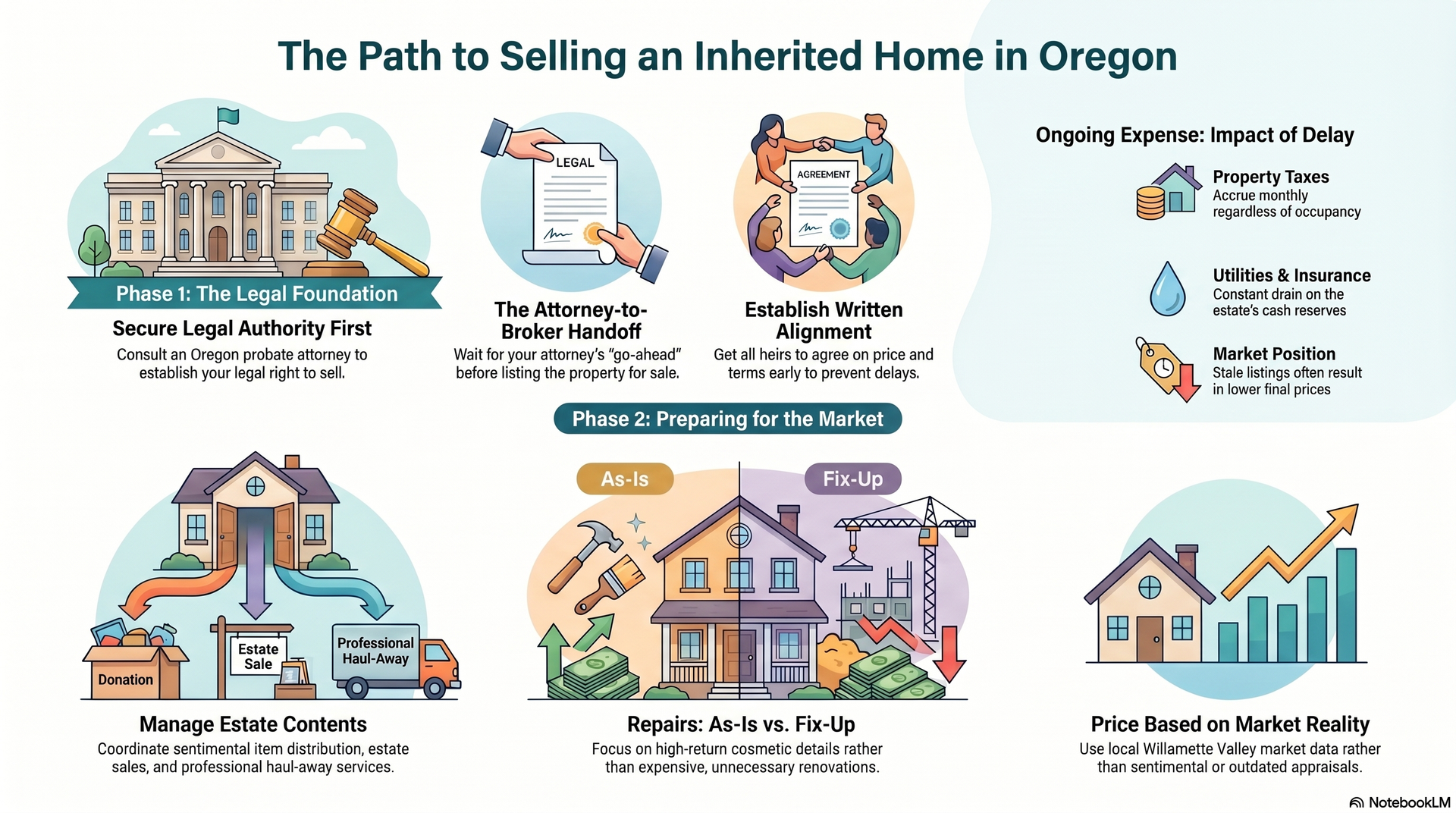
Your attorney will let you know when the time is right to bring a real estate broker into the process. That handoff point varies depending on the estate — but when your attorney gives you the go-ahead, that's when the practical work of preparing and selling the property can begin. That's where we come in.
What the Prep Process Actually Looks Like
Inherited homes often come with a layer of complexity that a standard home sale doesn't. They may have been lived in for decades, have deferred maintenance, or be full of furniture and personal belongings that still need to be sorted.
This is normal, and it's workable — but it takes honest assessment and a realistic plan.
Belongings and estate contents
Before a home can be prepared for market, the contents usually need to be addressed. This might mean coordinating with family members to claim sentimental items, working with a local estate sale company to sell remaining furnishings, or arranging donation pickups and haul-away services.
If you're managing this from out of town, or managing it alongside grief and family dynamics, having a broker with vendor connections is genuinely useful. We work regularly with estate sale planners, movers, and junk removal services in the Canby, Oregon City, and Willamette Valley area — and those vendor relationships mean calls get returned.
Repairs and condition
One of the most common questions we hear is whether the home needs to be fixed up before it can be listed. The honest answer is: it depends, and more often than not, less work is better than more.
For a deeper look at this question, our post on what not to fix before selling walks through the decision-making process in detail — but the short version is that repairs need to be weighed against likely return, timeline, and how the home will be priced. Inherited homes are sometimes better served by an honest as-is price than by a rushed renovation that doesn't fully pay off.
Staging and presentation
Even a home sold in largely as-is condition benefits from thoughtful presentation. Decluttering, improving room flow, and addressing the most visible cosmetic details can meaningfully affect buyer perception — and sale price. Ruth's background in home staging means this isn't guesswork; it's a trained eye applied to what's already there.
Pricing an Inherited Home Honestly
Inherited properties are sometimes the hardest to price — not because the market data isn't available, but because emotional anchoring and outdated assumptions about value can pull the number in the wrong direction.
A family member may remember the home being appraised years ago at a certain value. Or the estate may have a strong sentimental sense of what the home is "worth." Neither of these is the same as what today's buyers will pay in today's market.
A current comparative market analysis — based on recent, nearby sales and current inventory conditions in the Willamette Valley — is the only reliable foundation for a listing price. Pricing too high to "see what happens" costs time, adds carrying costs to the estate, and often results in a lower final sale price than a well-positioned listing would have achieved from the start.
We'll always give you a straight read on where the market is, including when the number is lower than you were hoping for.
Managing the Sale When Life Is Already Complicated
Selling a property is work under normal circumstances. Selling it while managing an estate — possibly from a distance, possibly while coordinating with siblings or other heirs, possibly while still processing loss — is a different kind of task.
A broker experienced in estate transitions understands that pace matters, communication matters, and that decisions sometimes take longer than a standard sale because more people are involved. We're used to working alongside attorneys, communicating updates to multiple family members, and coordinating vendors so that one person isn't carrying the entire logistical load.
We've spent years working alongside families navigating parent transitions — sitting in the conversations where adult children are trying to do right by a parent while managing their own lives, timelines, and emotions. That experience shapes how we approach estate sales: with patience, clear communication, and genuine respect for what families are going through.
When Multiple Heirs Are Involved
When more than one person stands to benefit from the sale, it's important to get written alignment on key decisions early — asking price, acceptable offer terms, and how proceeds will be split. The attorney handling the estate can help formalize this, but the practical conversations about the property itself often happen with the broker.
Disagreements between heirs are one of the most common reasons estate sales drag on — and delays carry a real financial cost. Property taxes, homeowner's insurance, and utilities continue accruing regardless of whether there's a mortgage on the property. Every month the home sits unsold is a month the estate is absorbing those expenses. Getting on the same page early, even when it's a hard conversation, almost always benefits everyone.
We've found that clear, consistent updates and honest information tend to reduce conflict rather than increase it. When everyone knows what the market actually looks like and what the options are, decisions tend to get easier.
Frequently Asked Questions
Do we need to complete the legal process before we can list the home?
In most cases, the personal representative needs legal authority to sell before a property can be listed. Your estate attorney will advise you on when it's appropriate to bring a real estate broker in. Once that go-ahead is given, the sale process can move forward normally.
What if the home needs a lot of work — does it have to be fixed before selling?
Not necessarily. Many inherited homes are sold in largely as-is condition with pricing that reflects their current state. The right approach depends on the condition, the timeline, and what repairs are likely to return value. We'll walk through this with you honestly rather than pushing for work that may not pay off.
How do we find a real estate broker who understands estate sales?
Ask specifically about experience with inherited or estate properties — it's a meaningful difference from a standard sale. You want someone who understands the pace of the process, communicates well with multiple parties, and has vendor relationships to help with property prep. Local knowledge matters too; a broker familiar with the Willamette Valley market will give you more accurate pricing guidance than someone working from general data.
If you're navigating an inherited property in the Canby, Oregon City, Salem, or broader Willamette Valley area and you're ready to start thinking about the selling side, we're glad to talk through what that looks like. Reach out for a local snapshot — no pressure, just real insights.
Ruth & Frank Howard, Brokers
Your Howard Team | Equity Oregon Real Estate
Local market knowledge across the Willamette Valley — from Canby and Oregon City to Salem, Keizer, Woodburn, Hubbard, and surrounding areas.
www.yourhowardteam.com
 All information provided is deemed reliable but is not guaranteed and should be independently verified. IDX information is provided exclusively for consumers' personal, non-commercial use, that it may not be used for any purpose other than to identify prospective properties consumers may be interested in purchasing, and that the data is deemed reliable but is not guaranteed accurate by RMLSTM.
The content relating to real estate for sale on this web site comes in part from the IDX program of the RMLSTM of Portland, Oregon. Real estate listings held by brokerage firms other than Equity Oregon Real Estate are marked with the RMLSTM logo, and detailed information about these properties includes the names of the listing brokers. Listing content is copyright © 2026 RMLSTM, Portland, Oregon.
This content last updated on September 21, 2026 1:28 PM UTC at 4 AM. Some properties which appear for sale on this web site may subsequently have sold or may no longer be available.
All information provided is deemed reliable but is not guaranteed and should be independently verified. IDX information is provided exclusively for consumers' personal, non-commercial use, that it may not be used for any purpose other than to identify prospective properties consumers may be interested in purchasing, and that the data is deemed reliable but is not guaranteed accurate by RMLSTM.
The content relating to real estate for sale on this web site comes in part from the IDX program of the RMLSTM of Portland, Oregon. Real estate listings held by brokerage firms other than Equity Oregon Real Estate are marked with the RMLSTM logo, and detailed information about these properties includes the names of the listing brokers. Listing content is copyright © 2026 RMLSTM, Portland, Oregon.
This content last updated on September 21, 2026 1:28 PM UTC at 4 AM. Some properties which appear for sale on this web site may subsequently have sold or may no longer be available.
