


Should You Accept a Contingent Offer on Your Home in the Willamette Valley?
A contingent offer means a buyer wants your home, but their ability to close depends on selling their own property first. It's not a red flag by itself — but it does come with real tradeoffs worth understanding before you sign anything.
If you've listed your home and a contingent offer comes in, it can feel like a strange kind of good news. Someone wants your house. They're willing to put an offer in writing. But there's a catch attached, and it's natural to wonder what you're actually agreeing to — and what happens if their sale falls through.
We walk sellers through this exact decision regularly here in the Willamette Valley. The short version: a contingent offer isn't automatically risky, and it isn't automatically safe. It depends on the buyer's situation, how the contingency is structured, and what protections you build in from the start.
What a Contingent Offer Actually Means
When a buyer submits a contingent offer, they're telling you their purchase depends on selling — and closing — their current home first. Until that happens, they typically don't have the funds to complete your transaction.
That's the core tradeoff: you may be getting a serious, motivated buyer, but your sale is now tied to the progress of theirs. The strength of that offer depends heavily on where their property stands. A buyer whose home is already listed and getting showings is in a very different position than a buyer who hasn't put their home on the market yet.
Why Sellers Hesitate — and What You're Actually Risking
The concern most sellers have isn't unreasonable: what if you take your home off active marketing, wait on this buyer's sale, and it doesn't happen?
In Oregon, you're not left without options here. A contingent offer is typically structured so your home stays in a marketable status — often called "Bumpable" on the MLS — while the buyer works to sell their property. That means you retain the right to keep showing your home and accepting other offers, even after agreeing to the contingent one.
You Set the Outer Deadline, Too
Beyond the bump process, you're not left waiting indefinitely even if no other offer ever comes in. As the seller, you can set a firm deadline by which the buyer must either notify you that they've accepted an offer on their own home, or remove the contingency altogether by proving they can complete the purchase without selling it. No competing offer has to show up to trigger this; it's simply a date on the calendar.
That date isn't something we just wait on. As your listing agent, we're tracking it closely and staying in regular contact with the buyer's agent throughout, so you always know where things stand well before the deadline arrives — not after. If it passes without that notice, the contract typically terminates automatically and earnest money is released, with no further negotiation required on your end. And if the buyer's close but needs a little more time, that deadline isn't fixed in stone either — you're free to offer an extension if it's in your interest to keep the deal moving rather than start over. It's one of the clearest ways a contingent offer stays a decision you control, not one that controls you.
How You Stay Protected While the Buyer Sells
This is the piece that makes contingent offers workable for sellers, and it's worth understanding clearly.
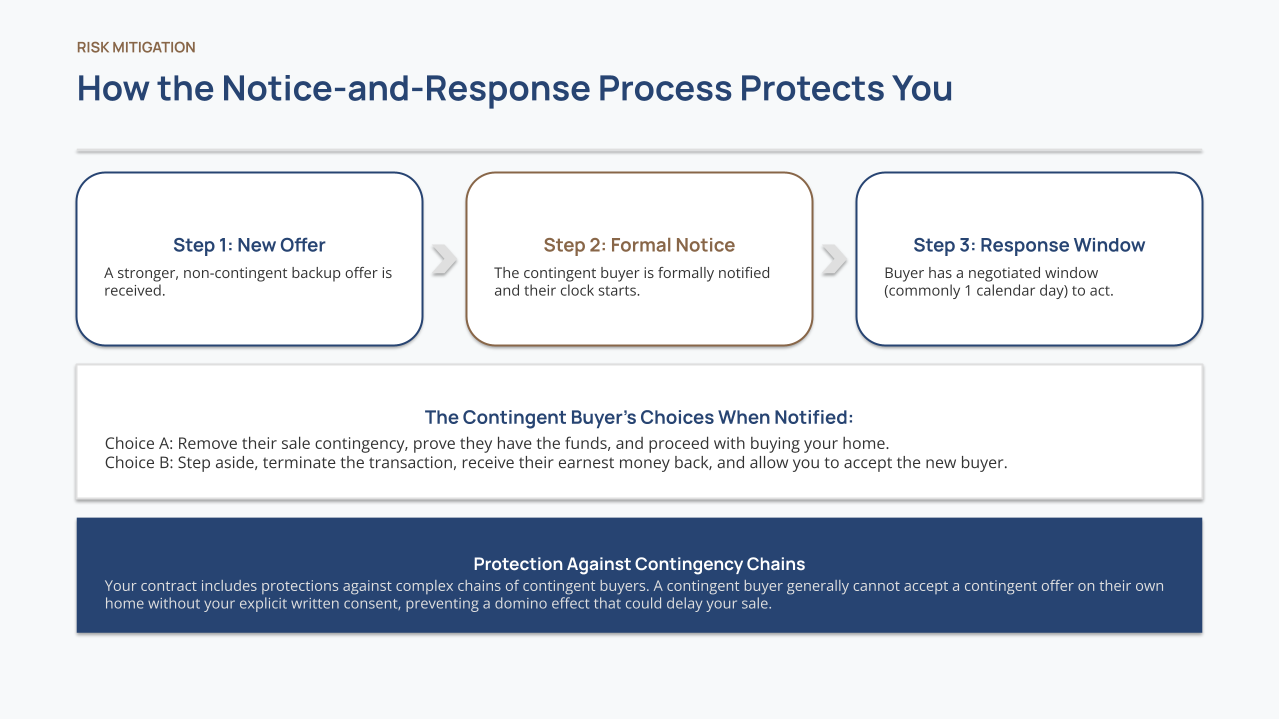
If a stronger, non-contingent offer comes in while you're under contract with a contingent buyer, you can formally notify that buyer. From there, they typically have a short window — often just a day or two — to respond in one of a few ways:
- Confirm they've already accepted an offer on their own home, keeping the deal moving with only their closing left as a contingency
- Prove to your satisfaction that they can complete the purchase without selling first — effectively removing the contingency altogether
- Step aside, at which point the transaction terminates and their earnest money is returned
If they don't respond within that window, it's typically treated as an automatic release — you're free to move forward with the other offer. That built-in deadline is what protects you from being stuck indefinitely.
One more layer of protection worth knowing: the buyer generally can't accept an offer on their own home that's itself contingent on another sale — without getting your written consent first. That keeps you from ending up several links deep in a chain of contingent sales, where your closing depends on someone else's closing, which depends on someone else's. If it's not disclosed and consented to upfront, it typically isn't allowed.
What We Actually Do Before You Decide
A contingent offer is only as good as the buyer's ability to follow through — which is why we don't just take the offer at face value. Before we advise you either way, we do our own homework.
We request the listing information for the buyer's current home directly from their agent — is it listed, how's it priced, what condition is it in. We look at how homes are actually moving in that specific area, not a general read on the market, but the real local picture for their property. We talk with the buyer's agent about what's being done to market their home and get a sense of where they stand financially, and we call their lender directly to understand their qualification.
Buyers who submit contingent offers are usually motivated to sell quickly, so their homes tend to be priced to move. If that's not the case — if their home is priced high, sitting without a real marketing plan, or their financing picture is unclear — that's worth a direct conversation with you before you decide anything.
What a Realistic Timeline Looks Like
Contingent offer terms in Oregon are negotiable, but there are common starting points worth knowing. If a buyer's property isn't already listed, contracts often default to giving them a short window — commonly three business days — to get it on the market. And once you notify a contingent buyer that a competing offer has come in, their response deadline is often as short as one calendar day.
Those numbers aren't fixed rules — they're negotiable between buyer and seller — but they give you a sense of how quickly this process is designed to move once it's triggered.
Questions to Ask Before You Say Yes
These are the same questions we're already digging into on your behalf — but it's worth knowing what we're looking at:
- Is the buyer's home already listed, or not yet on the market?
- How's their equity position — do the numbers support a smooth sale?
- What's the realistic timeline for their home to sell in today's market?
- Are they open to a shorter response window if a competing offer comes in?
When a Contingent Offer Might Be Worth It
A contingent offer isn't automatically the weaker choice. If the buyer's home is already listed, priced right, and in a segment of the market that's moving well, their contingency may resolve faster than you'd expect. And a serious, motivated buyer with a clear path to closing can sometimes be a better outcome than waiting for a hypothetical stronger offer that never comes.
The decision really comes down to how much certainty you need versus how strong the specific offer in front of you actually is.
Frequently Asked Questions
Can a seller back out of a contingent offer?
Generally, once you've accepted a contingent offer, you're bound by its terms — but the structure protects you in a few ways: you can set a firm outer deadline, keep marketing your home and act on a stronger offer through the notice-and-response process, and the buyer typically can't accept a contingent offer on their own home without your written consent.
How likely is a contingent offer to fall through?
It varies significantly based on the buyer's situation — how close they are to selling, their local market conditions, and how the contingency is structured. A buyer whose home is already under contract carries far less risk than one who hasn't listed yet.
What does a contingent offer mean in real estate?
It means the buyer's purchase depends on an outcome — most often selling their current home — before they can complete the transaction. The offer is valid, but conditional.
If you're weighing a contingent offer, or thinking through your own negotiating position as a buyer or seller in today's market, our recent guide on what negotiation looks like in the Willamette Valley now is a good next read.
Reach out for a local snapshot — no pressure, just real insights.
Ruth & Frank Howard, Brokers | Your Howard Team | Equity Oregon Real Estate
Serving Canby, Oregon City, Wilsonville, Woodburn, Aurora, Hubbard, and surrounding Willamette Valley communities.
Local market knowledge across the Willamette Valley — from Canby and Oregon City to Salem, Keizer, Woodburn, Hubbard, and surrounding areas.
 All information provided is deemed reliable but is not guaranteed and should be independently verified. IDX information is provided exclusively for consumers' personal, non-commercial use, that it may not be used for any purpose other than to identify prospective properties consumers may be interested in purchasing, and that the data is deemed reliable but is not guaranteed accurate by RMLSTM.
The content relating to real estate for sale on this web site comes in part from the IDX program of the RMLSTM of Portland, Oregon. Real estate listings held by brokerage firms other than Equity Oregon Real Estate are marked with the RMLSTM logo, and detailed information about these properties includes the names of the listing brokers. Listing content is copyright © 2026 RMLSTM, Portland, Oregon.
This content last updated on September 21, 2026 1:28 PM UTC at 4 AM. Some properties which appear for sale on this web site may subsequently have sold or may no longer be available.
All information provided is deemed reliable but is not guaranteed and should be independently verified. IDX information is provided exclusively for consumers' personal, non-commercial use, that it may not be used for any purpose other than to identify prospective properties consumers may be interested in purchasing, and that the data is deemed reliable but is not guaranteed accurate by RMLSTM.
The content relating to real estate for sale on this web site comes in part from the IDX program of the RMLSTM of Portland, Oregon. Real estate listings held by brokerage firms other than Equity Oregon Real Estate are marked with the RMLSTM logo, and detailed information about these properties includes the names of the listing brokers. Listing content is copyright © 2026 RMLSTM, Portland, Oregon.
This content last updated on September 21, 2026 1:28 PM UTC at 4 AM. Some properties which appear for sale on this web site may subsequently have sold or may no longer be available.
