
The Affordability Story Nobody's Talking About in Oregon
Is Oregon housing becoming more affordable? In parts of Oregon, more inventory, plateauing prices, and meaningful price variation across communities are quietly shifting conditions in the mid-Willamette Valley — even as interest rates remain elevated and economic uncertainty continues to weigh on the market.
The headlines about housing affordability are real. For a lot of families in Oregon, the math has been genuinely hard for several years — higher prices, elevated rates, and not enough homes to go around. That's not a narrative problem. It's the lived experience of a lot of people we talk to every day.
What the headlines don't always capture is the nuance. Not every market in Oregon looks the same. Not every price point is equally out of reach. And the experience of buying or selling a home here in the Willamette Valley has shifted in ways that are worth understanding — even if they don't make for dramatic news coverage.
We work with sellers, buyers, and families navigating major life transitions across this corridor — from Canby and Oregon City to Salem, Keizer, Woodburn, Hubbard, and surrounding communities. What we're seeing on the ground is more nuanced than the national story suggests. This post is our attempt to tell the local version honestly, with real data behind it.
What "Affordability" Actually Means Right Now
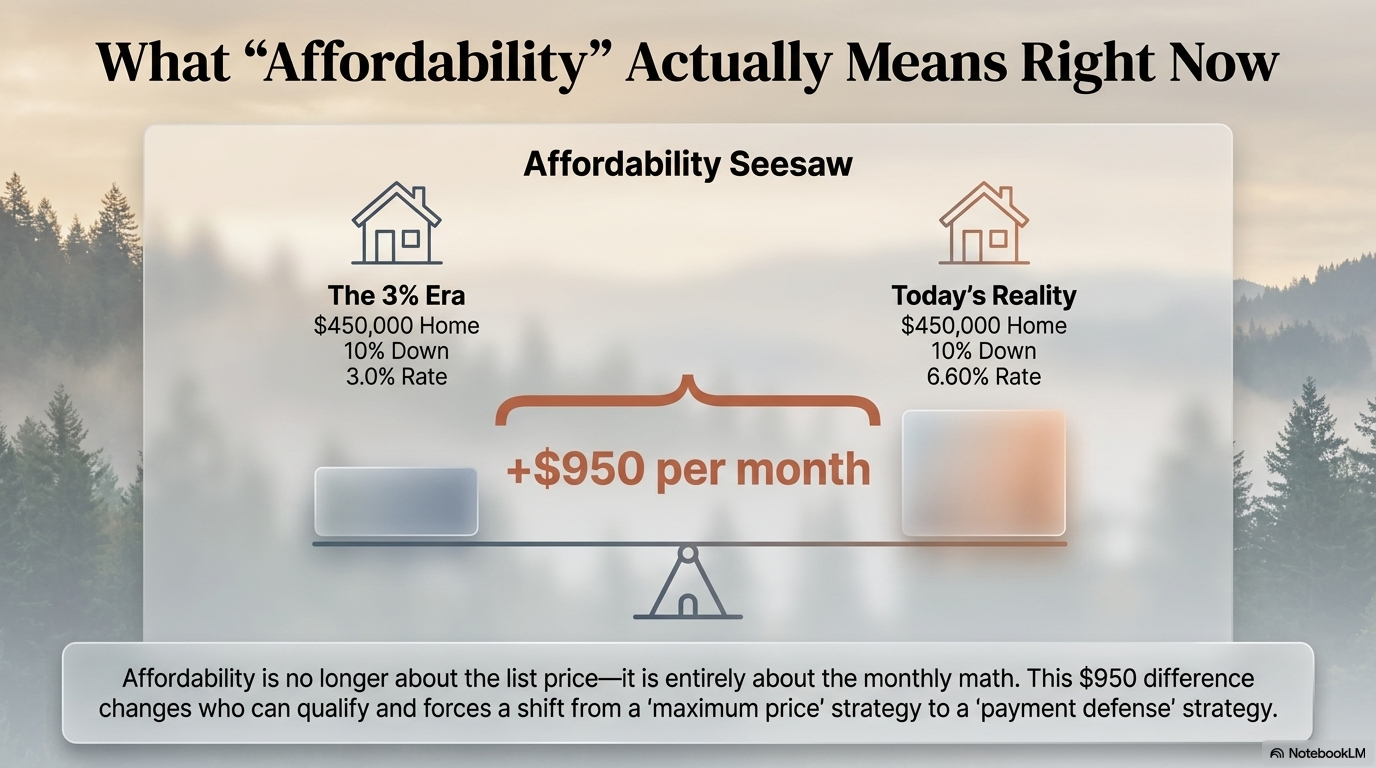
Affordability is not the same as a low price point. What affordability actually measures is whether the monthly payment on a home works within a real household budget — and that calculation involves more than just the list price.
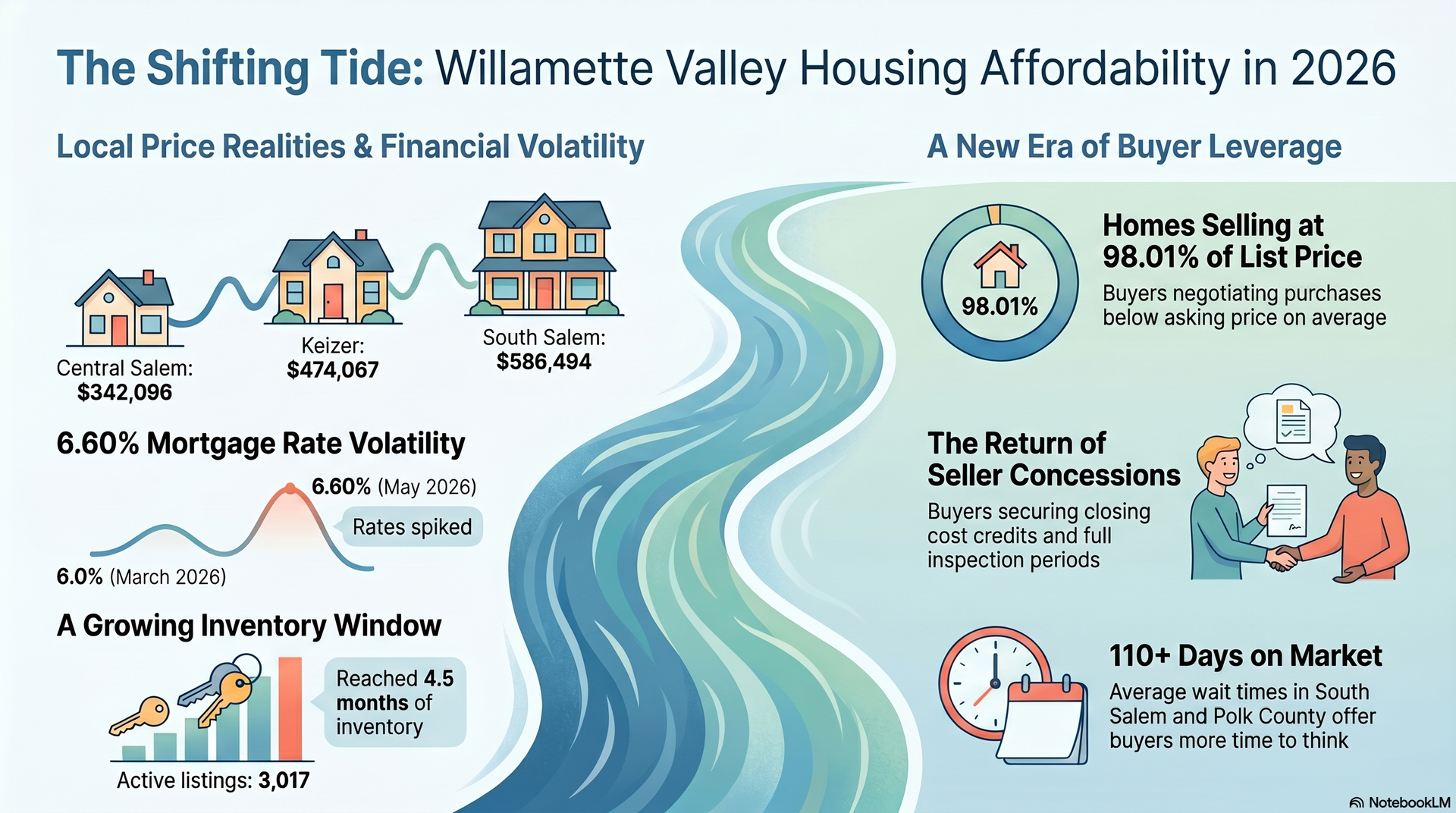
Right now, 30-year fixed mortgage rates are sitting at 6.60%, according to Mortgage News Daily. That is meaningfully higher than where rates were just a few years ago, and it has a real impact on monthly payments. On a $450,000 home with 10% down, the difference between a 3% rate and a 6.60% rate is roughly $950 per month. That's not a rounding error — it changes who can qualify, what price range makes sense, and how buyers are approaching the decision entirely.
At the same time, home prices across much of the Willamette Valley have plateaued. According to the Willamette Valley MLS, the average sale price across the valley in April 2026 was $477,294 — up modestly from $464,839 in April 2025. That's not a crash, and it's not rapid appreciation either. For buyers, that stability means more predictability. For sellers, it means pricing strategy matters more than it did when any price seemed to work.
The affordability story isn't simple. But it's more nuanced than the national conversation suggests, and it looks different depending on where in this valley you're looking.
The Farther You Go, the More the Story Changes
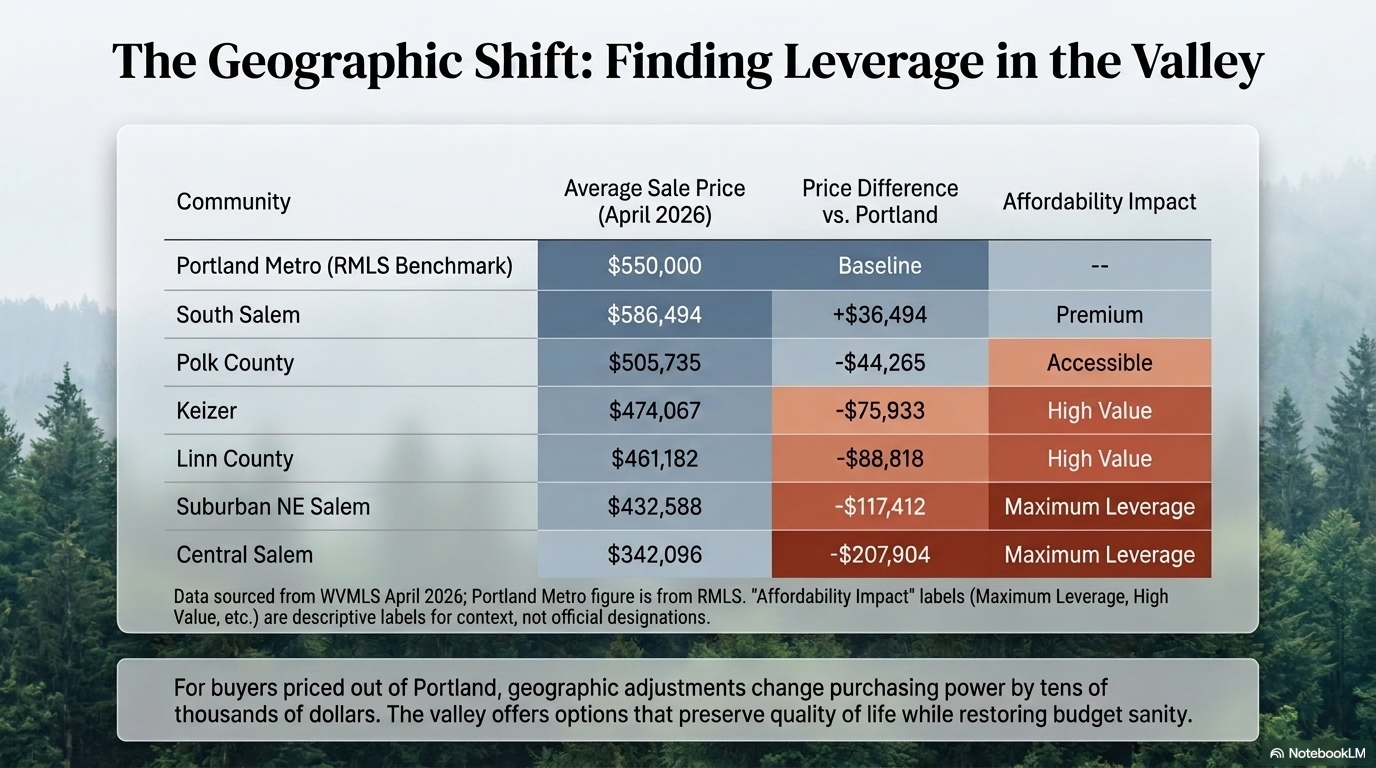
The Willamette Valley is not one housing market. It's a corridor of distinct communities, each with its own price reality, its own pace, and its own buyer pool.
According to April 2026 data from the Willamette Valley MLS, average sale prices across the region tell a clear story about what different communities are actually offering buyers right now. Communities like Central Salem and the suburban areas east of Salem are offering meaningful price differences compared to Portland Metro's median of $550,000 — not in the hundreds of dollars, but in the tens of thousands. That gap translates directly into monthly payment differences that change what's possible for a real household budget.
We're careful about leaning too hard on any single month's data. Averages shift, and in smaller communities a handful of sales can move the numbers significantly. WVMLS itself notes that many factors contribute to fluctuations and that users should analyze data over an extended period to ascertain trends. What we can say with confidence is that the range across this corridor is real, and the direction has been consistent.
For buyers who have been priced out of Portland or the communities immediately surrounding it, this valley offers options that don't require giving up quality of life — and often come with more space, more land, and a different pace that many of our clients find they actually prefer.
What Sellers Are Sitting On — and May Not Realize
If you've owned your home in the Willamette Valley for more than a few years, there's a reasonable chance you're sitting on more equity than you realize.
The WVMLS average sale price data going back to 2012 makes this visible in a way that's hard to argue with. The average across the valley in 2012 was $196,867. By 2021 it had climbed to $437,669. Even through the moderation of recent years, the 2026 YTD average sits at $515,423. That's a long-run appreciation story that hasn't reversed — it's just leveled off.
That equity has real implications, particularly for sellers who are also looking to purchase something smaller. This is a situation we work with frequently — homeowners who are ready to downsize, move closer to family, or simplify their lives, but who feel uncertain about how the numbers will work on the other side of the transaction.
Here's what often surprises people: in a market where prices have plateaued and buyers have more negotiating room, the home you're purchasing on the other end of the transaction benefits from the same conditions. The seller you'll be buying from is facing the same market you're selling into. For the right seller, that dynamic is worth exploring carefully with someone who knows the local numbers.
What Buyers Are Quietly Getting Right Now
For the first time in quite a while, buyers in the Willamette Valley are getting things they simply haven't seen in years.
Concessions. Closing cost credits that help offset the sting of higher rates. Sellers who are willing to negotiate on price rather than holding firm and waiting for a backup offer that may not come. Inspection periods that are actually being used. Time to think.
The data supports this. Across the Willamette Valley in April 2026, homes were selling at an average of 98.01% of list price, according to WVMLS — meaning buyers are, on average, purchasing below asking. Days on market across the valley tell the same story: Polk County averaged 140 days, Marion County 115 days, South Salem 110 days. These are not frantic, multiple-offer conditions. They are markets where preparation, patience, and a clear understanding of value give buyers real leverage.
None of this is guaranteed on every property. Well-priced, well-prepared homes in desirable locations still move, and competitive situations do happen. But the dynamic has shifted from what it was. The era of waiving everything, skipping inspections, and writing offers sight unseen is not the experience most buyers are having in this market right now.
For buyers who tried during the peak years and walked away frustrated — this is worth a second look.
Why This Window Has a Real Ceiling
We wouldn't be doing our job if we didn't say this plainly: the conditions creating breathing room for buyers right now are not guaranteed to last, and there are real forces that could tighten things back up.
Mortgage rates are being driven by factors well outside of anyone's local control. As of this writing, the 30-year fixed rate sits at 6.60% and today's trend is moving in the wrong direction, according to Mortgage News Daily. Rates touched close to 6% earlier this year before climbing back — and the forces driving that reversal, including global oil market pressure and inflation that has proven stickier than expected, haven't resolved. Anyone who tells you confidently where rates will be in six months is guessing.
Oregon also has a structural housing supply problem that hasn't gone away. The state has not built enough homes to keep pace with demand for years, and that supply constraint puts a floor under prices in most markets. Inventory across the Willamette Valley is up — WVMLS reports 3,017 active listings compared to 2,872 a year ago, with months of inventory at 4.5 — but we are not in oversupply territory. What we have right now is a window of relative balance. That window could close as conditions shift.
The point isn't to create urgency. It's to be honest about what's real.
Frequently Asked Questions
Is it a good time to buy a home in Oregon right now?
It depends heavily on your personal financial situation, your timeline, and what you're looking for. What the data shows is that conditions are more favorable for buyers than they've been in quite some time — more inventory, more negotiating room, and homes selling below asking price across much of the Willamette Valley. Whether that translates to the right time for you is a conversation worth having with someone who knows the local market and can look at your specific numbers. Rates are elevated and real affordability challenges remain, but the experience of buying has changed meaningfully.
Are home prices dropping in the Willamette Valley?
Not dramatically. Prices have plateaued across much of the corridor — the rapid appreciation of recent years has slowed significantly — but there are no widespread, sharp price declines. Some markets are seeing modest softening, particularly where sellers have been overpriced or where days on market have climbed. The more accurate picture is that the valley offers a wide range of price points across different communities, and buyers have more room to negotiate than they did just a few years ago.
Should I wait for interest rates to drop before buying?
Waiting for rates to drop is a reasonable instinct, but it carries real risk. Rates are being driven by factors — inflation, global events, Federal Reserve policy — that are genuinely difficult to predict. If rates do drop significantly, buyer demand tends to increase quickly, which puts upward pressure on prices and brings competition back. Many buyers who wait for a better rate find themselves in a more competitive market when that rate arrives. The better question is usually whether the payment works today and whether the home fits your life.
Ready for a Local Snapshot?
We work with buyers, sellers, and families navigating transitions across the Willamette Valley — from Canby and Oregon City to Salem, Keizer, Woodburn, Hubbard, and surrounding communities. If you're trying to make sense of what this market means for your specific situation, we're happy to talk it through.
Reach out for a local snapshot — no pressure, just real insights.
Ruth & Frank Howard, Brokers | Your Howard Team | Equity Oregon Real Estate
Licensed in Oregon | yourhowardteam.com
Data sources: Willamette Valley MLS (WVMLS) April 2026 Valley Real Estate Review; RMLS Portland Metro and Polk & Marion Counties Market Action Reports, April 2026; Mortgage News Daily, June 2026.
 All information provided is deemed reliable but is not guaranteed and should be independently verified. IDX information is provided exclusively for consumers' personal, non-commercial use, that it may not be used for any purpose other than to identify prospective properties consumers may be interested in purchasing, and that the data is deemed reliable but is not guaranteed accurate by RMLSTM.
The content relating to real estate for sale on this web site comes in part from the IDX program of the RMLSTM of Portland, Oregon. Real estate listings held by brokerage firms other than Equity Oregon Real Estate are marked with the RMLSTM logo, and detailed information about these properties includes the names of the listing brokers. Listing content is copyright © 2026 RMLSTM, Portland, Oregon.
This content last updated on September 22, 2026 5:03 PM UTC at 4 AM. Some properties which appear for sale on this web site may subsequently have sold or may no longer be available.
All information provided is deemed reliable but is not guaranteed and should be independently verified. IDX information is provided exclusively for consumers' personal, non-commercial use, that it may not be used for any purpose other than to identify prospective properties consumers may be interested in purchasing, and that the data is deemed reliable but is not guaranteed accurate by RMLSTM.
The content relating to real estate for sale on this web site comes in part from the IDX program of the RMLSTM of Portland, Oregon. Real estate listings held by brokerage firms other than Equity Oregon Real Estate are marked with the RMLSTM logo, and detailed information about these properties includes the names of the listing brokers. Listing content is copyright © 2026 RMLSTM, Portland, Oregon.
This content last updated on September 22, 2026 5:03 PM UTC at 4 AM. Some properties which appear for sale on this web site may subsequently have sold or may no longer be available.
