

What does home staging mean for sellers in the Willamette Valley? Home staging is the process of preparing your home so it presents at its absolute best — in photos, in person, and in the mind of every buyer who walks through the door. For our clients at Your Howard Team, staging guidance is part of how we work, whether your home is fully occupied, partially cleared out, or completely vacant.
If you're getting ready to sell a home you've lived in for years — or helping a parent through that process — this post walks you through exactly what staging looks like in practice, how we approach it with our clients, and why it matters more now than it ever has.
The First Showing of Your Home Is Online
Before a buyer ever sets foot in your home, they've already formed an opinion about it.
In today's market, your listing photos are your first showing. Buyers scroll through dozens of homes on their phones and laptops, and they make fast decisions about which ones are worth their time. A home that photographs well gets clicks, inquiries, and scheduled showings. A home that doesn't gets passed over — faster than most people expect.
This is why we always include professional photography as part of our listing services. And it's also why staging comes first. There's no point investing in great photography if the home isn't ready for it. The two work together, and the order matters: you stage, then you photograph.
When a home is well-presented in photos, we see the difference immediately — more engagement on the listing, more calls from agents, more interest from buyers who might otherwise have moved on. It also significantly increases your chances of getting the price you want for your home. And when a home isn't prepared? Even strong photography can only do so much with a cluttered room or furniture arranged in a way that makes the space feel smaller than it is.
The goal is simple: get buyers through your door. Everything else follows from that.
What Staging Actually Looks Like in an Occupied Home
When we begin the staging process with a client, we start with a room-by-room walk-through together. We take notes and snapshots along the way — working photos on our end to help us remember each space, note wall dimensions, ceiling heights, and anything we might want to address before the professional photographer arrives. It's a working session, not a formal assessment, and it sets the foundation for everything that follows.
One of the first things we ask is what our clients loved about their home when they bought it — what drew them to it, what they've always liked most about it. Those answers matter. Staging isn't just about editing and arranging. It's about highlighting a home's best features, and the people who've lived there are often the best source of insight into what those features are.
Before staging begins in earnest, we also make sure the foundational preparation is in place. Paint that needs touching up, windows that need cleaning, repairs that should be addressed before the home is photographed — all of that comes first. If you're unsure what repairs are worth making before you list, our post on what not to fix before selling is a good place to start.
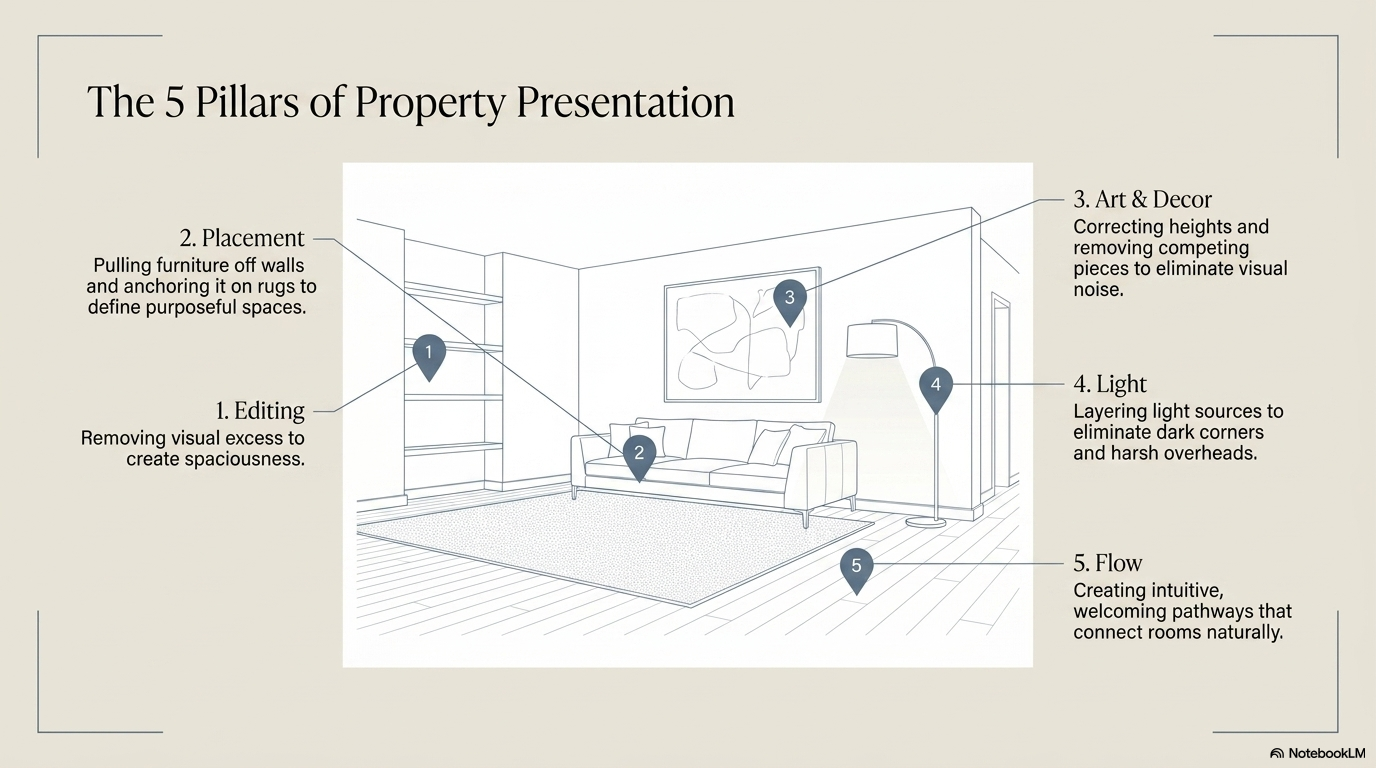
From there, we build a list and a timeline so nothing falls through the cracks. Here's what we're typically looking for:
Editing. Almost every home has too much in it — too much furniture, too many accessories, too many things on every surface. This isn't a criticism of how someone lives. It's simply a reality of the difference between a home that works for daily life and a home that photographs well and feels spacious to a buyer walking through for the first time.
Furniture placement. It's very common to find furniture pushed against the walls, which actually makes rooms feel smaller, not larger. When pieces are pulled out, grouped intentionally, and anchored on a rug, the room reads as more open and more purposeful.
Art and wall decor. This is one of the most consistent things we see in longtime family homes: art that's hung too high, too low, or simply in the wrong place for the room. The right piece in the right spot can anchor a room completely. The wrong placement, or too many pieces competing with each other, creates visual noise that buyers feel even if they can't name it.
Light. Properly placed lighting makes rooms feel warmer and larger. We look at every room for dark corners, harsh overhead lighting, and missed opportunities to add warmth through layered light sources.
Flow. A buyer should be able to move through your home naturally, without feeling like they're navigating around things. We look at how each room connects to the next and whether the path through the home feels open and welcoming.
The finishing touches. Sometimes a space needs a few additional pieces to feel complete — something on a wall, something on a surface, something that pulls a room together visually. How we handle that varies by situation. Sometimes clients choose to purchase a few items they'll enjoy in their new home anyway, and we use them during the listing. Sometimes we draw from our own supply of pieces we keep on hand for exactly this purpose. It's flexible, and we figure it out together based on what each home actually needs.
After the walk-through, our clients have a clear picture of what needs to happen, in what order, and by when.
You're Not Decluttering — You're Starting to Pack
It's one thing to talk about decluttering in the abstract, and another to stand in a room you've lived in for twenty years and start deciding what stays and what goes. The process is personal, and it isn't always easy.
Lived-in homes are full of things that have accumulated over years of real life — furniture, collections, decor that tells the story of a family in a space. That's not a problem. That's just the starting point.
What staging does is shift that starting point toward something more neutral and more spacious — not because anything about the home is wrong, but because buyers need to be able to imagine themselves in it. And many clients find that the process, once they're in it, feels more liberating than they expected. This is a good time to let go of things you've been meaning to let go of for years. What gets packed is ready to move. What gets donated or discarded is one less thing to deal with later. Either way, you're further along than you were.
We'll also be honest: keeping a staged home tidy during showings takes some effort. The way we arrange things won't always be the most convenient configuration for daily life. We try to make it as livable as possible, but we want sellers to go in with realistic expectations. It's temporary — and it's worth it.
When Some Furniture Stays and Some Goes
Sometimes the conversation about what stays and what goes happens well before we ever list — and that's exactly how we prefer it.
Many of our clients, particularly those with significant equity in their home, are able to purchase their next home before they sell. When that's the plan, we talk early about what the transition should look like from a staging perspective. Rather than moving everything out at once, we'll often recommend leaving certain pieces in place for as long as possible — specifically in the dining room, living room, and primary bedroom. These are the rooms buyers respond to most strongly, and having even a few well-chosen pieces of furniture in them makes a significant difference in how the home photographs and shows.
If you can live without something for a while, leaving it behind until after closing can be one of the simplest and most effective staging decisions you make. We help you think through which pieces are worth keeping in place and which ones make sense to move earlier. It's a conversation, and we have it together as part of the overall plan.
When the Home Is Vacant
An empty home presents its own set of challenges. Without furniture, rooms can feel smaller than they are, buyers struggle to understand how a space functions, and photos tend to flatten everything in a way that doesn't do the home justice.
When a home is fully vacant, one option worth discussing is bringing in a professional staging company — a stager who works with a warehouse of furniture and can furnish key rooms specifically for the listing. This is the most involved staging scenario, and whether it makes sense depends on the home, the price point, and the specific situation.
This is always a conversation we have with our clients when it's relevant. There's no single answer that fits every home, and we help you think through whether the investment is likely to make a meaningful difference. If you're in this situation, the best thing to do is talk to us early so we can plan accordingly.
What Buyers Decide in the First Two Minutes
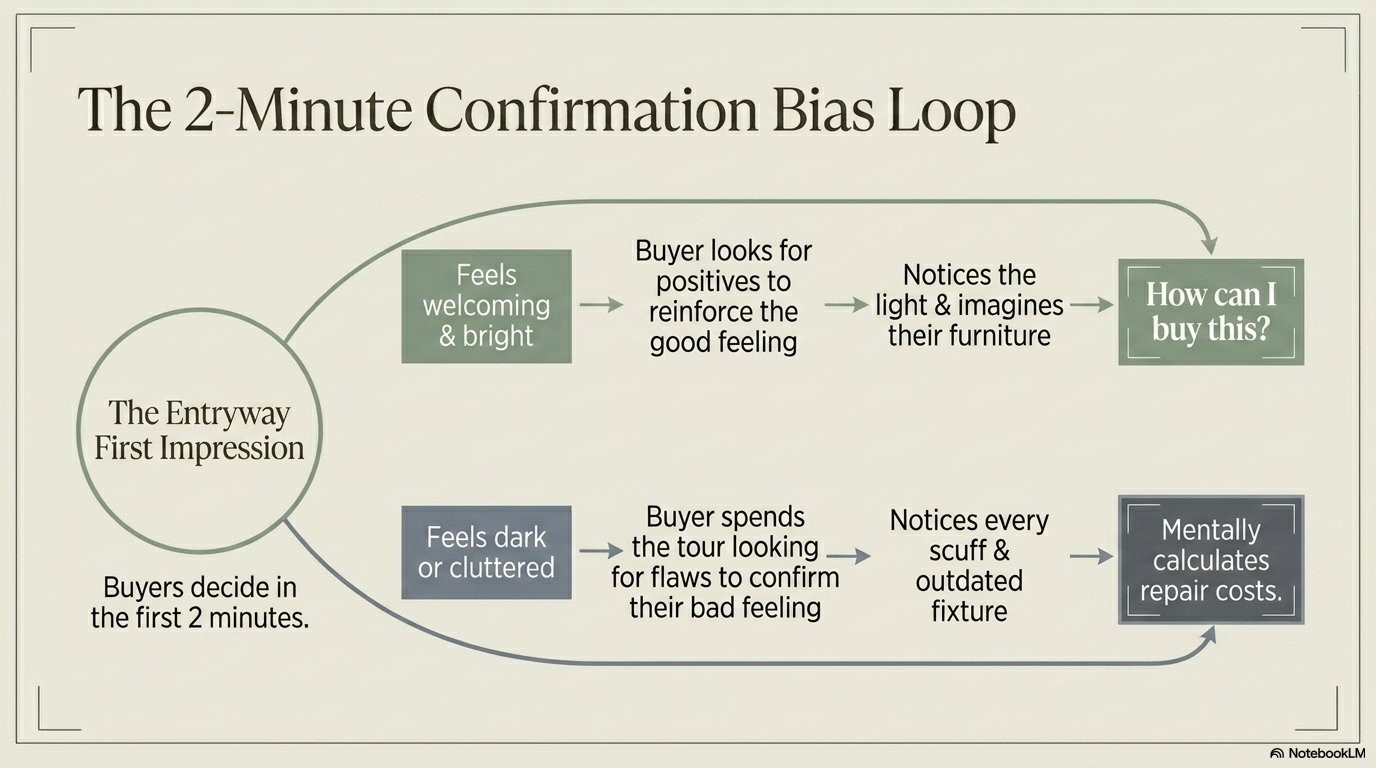
Here's something we've watched happen over and over in this business: buyers make up their minds about a home very quickly. Sometimes it happens in the entryway. Sometimes it's before they've even made it to the kitchen.
If that first impression is negative — if something feels off, cluttered, dark, or unwelcoming — it's very hard to turn around. The buyer spends the rest of the showing looking for reasons to confirm what they already felt. They notice every flaw. They start mentally calculating what it would cost to fix things.
But when that first impression is positive? The opposite happens. Buyers walk through looking to reinforce the good feeling they walked in with. They notice the light. They imagine their furniture in the living room. They start talking about what it would be like to live there.
Staging doesn't manufacture that feeling. But it creates the conditions for it — and in a market where buyers have more choices than they did a few years ago, that first impression matters more than ever.
Frequently Asked Questions
Is staging worth it if my home is already clean and tidy?
Clean and tidy is a great starting point — but it's not the same as staged. Staging is about presentation, placement, and creating a visual story that works for a wide range of buyers. A clean home with furniture pushed against the walls, personal photos on every surface, and overhead lighting as the only light source will still benefit significantly from a staging consultation. The changes are often small, but the difference in how the home photographs and shows can be substantial.
Do I have to buy new furniture or décor to stage my home?
Not necessarily. Our approach starts with what you already have — editing, rearranging, and refining rather than replacing. When additional pieces would make a meaningful difference, we work through that together. Sometimes clients choose to purchase items they'll enjoy in their new home anyway. Sometimes we bring in pieces from our own supply. It depends on the home and what it needs.
What if I've already moved out and the house is empty?
An empty home is workable, but it does require a different approach. We'll talk through your options — which may include bringing in a professional staging company, keeping a few key pieces in place longer than originally planned, or a combination of both. The right answer depends on your home and your timeline. Reach out and we'll figure it out together.
Your home deserves to be seen at its best. So do you.
Staging isn't about making your home look like someone else's — it's about helping it show as well as it possibly can, so the buyers who are right for it can see that immediately.
If you're getting ready to sell in the Willamette Valley and want to know what this process would look like for your specific home, we're happy to walk you through it. For a broader look at what to expect when selling, visit our First-Time Seller's Field Guide.
Reach out for a local snapshot — no pressure, just real insights.
Ruth & Frank Howard, Brokers | Your Howard Team | Equity Oregon Real Estate
Serving Canby, Oregon City, Wilsonville, Woodburn, Aurora, Hubbard, and surrounding Willamette Valley communities.
Local market knowledge across the Willamette Valley — from Canby and Oregon City to Salem, Keizer, Woodburn, Hubbard, and surrounding areas.
 All information provided is deemed reliable but is not guaranteed and should be independently verified. IDX information is provided exclusively for consumers' personal, non-commercial use, that it may not be used for any purpose other than to identify prospective properties consumers may be interested in purchasing, and that the data is deemed reliable but is not guaranteed accurate by RMLSTM.
The content relating to real estate for sale on this web site comes in part from the IDX program of the RMLSTM of Portland, Oregon. Real estate listings held by brokerage firms other than Equity Oregon Real Estate are marked with the RMLSTM logo, and detailed information about these properties includes the names of the listing brokers. Listing content is copyright © 2026 RMLSTM, Portland, Oregon.
This content last updated on September 21, 2026 1:28 PM UTC at 4 AM. Some properties which appear for sale on this web site may subsequently have sold or may no longer be available.
All information provided is deemed reliable but is not guaranteed and should be independently verified. IDX information is provided exclusively for consumers' personal, non-commercial use, that it may not be used for any purpose other than to identify prospective properties consumers may be interested in purchasing, and that the data is deemed reliable but is not guaranteed accurate by RMLSTM.
The content relating to real estate for sale on this web site comes in part from the IDX program of the RMLSTM of Portland, Oregon. Real estate listings held by brokerage firms other than Equity Oregon Real Estate are marked with the RMLSTM logo, and detailed information about these properties includes the names of the listing brokers. Listing content is copyright © 2026 RMLSTM, Portland, Oregon.
This content last updated on September 21, 2026 1:28 PM UTC at 4 AM. Some properties which appear for sale on this web site may subsequently have sold or may no longer be available.
