


If a seller disclosure reveals more than the price seems to account for, start by separating two questions: is this a legal disclosure issue, or a pricing and negotiation issue? They call for different conversations — and different people to ask.
If you're representing a buyer, you're not waiting for the disclosure to ask questions — a roof's age and condition, for instance, is something we're already asking about before an offer even goes in. But not everything is visible from the outside, and some things only come to light through inspection or in the disclosure itself once you're under contract. When something unexpected does show up in the disclosure, buyers naturally want to know: does this mean I overpaid? It's a fair question, and a common one. The good news is that this moment isn't a crisis — it's a decision point, and there's a clear way to work through it.
This Doesn't Automatically Mean the Deal Is Off
Disclosure and pricing are two separate things that happen to intersect on the same form. Oregon law requires sellers to disclose known material issues regardless of what the home is priced at, and a lower price doesn't excuse a seller from disclosing something they know about. So finding an unexpected item on the disclosure doesn't necessarily mean the price is wrong — it might already be reflected there, or it might not be.
We recently wrote about how sellers and their agents actually think through that pricing decision — including the five-business-day window Oregon buyers have to revoke an accepted offer once a disclosure is delivered. If you want the full mechanics of how that timeline and the pricing decision work from the seller's side, that piece is worth a read. Here, we're focused on what you do with the information once it's in front of you.
Sort the Question Before You React
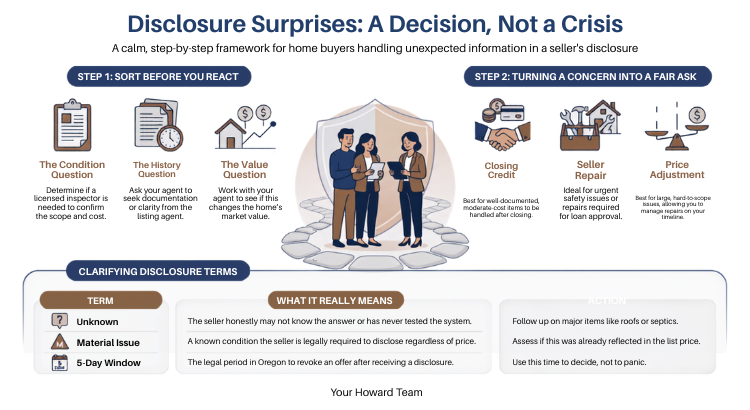
Not every disclosure item needs the same response. Before you decide anything, it helps to sort what you're looking at into one of three buckets:
- A condition question. Something that needs a licensed inspector to confirm scope and cost — a roof, a foundation note, an aging system.
- A history question. Something that needs a conversation, usually through your agent to the listing agent — when did this happen, was it repaired, is there documentation.
- A value question. Something that needs your own agent and comparable sales to answer — does this change what the home is actually worth to you.
Most disclosure surprises are really two of these tangled together. Separating them makes the next step much clearer, and it keeps you from treating a simple history question like a five-alarm inspection issue.
What "Unknown" Really Means on an Oregon Disclosure Form
Oregon's disclosure form allows sellers to answer certain questions with "Unknown" rather than "Yes" or "No." It's worth understanding what that actually means before drawing any conclusions. A seller who's owned the home a short time, inherited it, or never had a reason to test a specific system honestly may not know the answer — and Oregon law doesn't require sellers to guess or investigate beyond what they actually know.
That said, "Unknown" is worth a follow-up question when it appears on something significant — a roof, a septic system, a known structural area — rather than something minor. Your agent can request more information or recommend a targeted inspection for anything marked this way that matters to your decision. The goal isn't suspicion; it's clarity.
Questions Worth Asking Your Agent (Not the Seller Directly)
Buyers sometimes feel the instinct to ask the seller directly about something on the disclosure. In Oregon, that conversation almost always goes through your agent to the listing agent instead — it keeps the record clean and avoids putting a seller in an awkward spot answering informally. A few questions worth bringing to your agent:
- Has this issue already been reflected in the list price, based on comparable homes in similar condition?
- Is this a newly known issue, or something that's been part of the disclosure since listing?
- What would a licensed inspector need to look at to confirm the scope?
- Does this change our offer, or does it belong in a repair or credit request after inspection?
Your agent can often get a sense of the answer before you spend money on an additional inspection, which helps you decide where that money is best spent.
Turning a Concern Into a Fair Ask
If an inspection confirms the disclosure item is real and worth addressing, you generally have three ways to ask for it to be handled: a price adjustment, a credit at closing, or a repair completed by the seller before you close. Which one makes sense depends on urgency and documentation. A well-documented, moderate-cost item is often easiest to resolve as a credit. Something urgent or safety-related may be worth requesting as a completed repair, so you're not managing a contractor during your first weeks in the home. Depending on the loan type, it may not be optional either — some safety-related issues can become a condition of loan approval rather than simply a negotiating point, so it's worth looping in your lender early if you suspect that's the case. A larger, harder-to-scope issue sometimes makes more sense as a price adjustment, giving you flexibility to handle it on your own timeline.
There's no single right answer here, and it's rarely worth digging in on principle. The strongest asks are specific, backed by an inspector's findings, and proportional to the actual cost — not the surprise of finding it.
When It's Worth Walking Away
Most disclosure surprises don't end a transaction. Occasionally, one should. If an issue turns out to be more extensive than disclosed, if a seller can't produce documentation for repairs they claim were made, or if the cost and disruption genuinely exceed what you're comfortable taking on, your contingency rights are there to protect you. We covered the specific legal window for that in our companion piece on pricing and disclosure — worth reviewing if you're weighing that decision right now.
Whatever you decide, it's a decision, not a crisis. Disclosure exists to give you information before you're locked in, not to create a reason to panic once you have it.
FAQ
What's the difference between a disclosed issue and a genuine red flag?
A disclosed issue is something the seller has told you about, in writing, before you're locked into the deal. A red flag is something that doesn't match what's been disclosed, or that surfaces during inspection despite a clean disclosure — that's worth a closer look and a conversation with your agent.
Can I request a second inspection based on something in the disclosure?
Yes. If a general inspection or the disclosure itself raises a specific concern — roof, foundation, septic, electrical — a specialized inspector can give you a more precise answer before you decide how to proceed.
Does answering "Unknown" mean a seller is hiding something?
Not usually. Oregon disclosure law only requires sellers to share what they actually know. "Unknown" is common for recent owners, inherited properties, or systems that have never needed attention. It's worth a follow-up question on major items, but it isn't itself evidence of concealment.
Reach out for a local snapshot — no pressure, just real insights.
Ruth & Frank Howard, Brokers | Your Howard Team | Equity Oregon Real Estate
Serving Canby, Oregon City, Wilsonville, Woodburn, Aurora, Hubbard, and surrounding Willamette Valley communities.
Local market knowledge across the Willamette Valley — from Canby and Oregon City to Salem, Keizer, Woodburn, Hubbard, and surrounding areas.
 All information provided is deemed reliable but is not guaranteed and should be independently verified. IDX information is provided exclusively for consumers' personal, non-commercial use, that it may not be used for any purpose other than to identify prospective properties consumers may be interested in purchasing, and that the data is deemed reliable but is not guaranteed accurate by RMLSTM.
The content relating to real estate for sale on this web site comes in part from the IDX program of the RMLSTM of Portland, Oregon. Real estate listings held by brokerage firms other than Equity Oregon Real Estate are marked with the RMLSTM logo, and detailed information about these properties includes the names of the listing brokers. Listing content is copyright © 2026 RMLSTM, Portland, Oregon.
This content last updated on September 21, 2026 1:28 PM UTC at 4 AM. Some properties which appear for sale on this web site may subsequently have sold or may no longer be available.
All information provided is deemed reliable but is not guaranteed and should be independently verified. IDX information is provided exclusively for consumers' personal, non-commercial use, that it may not be used for any purpose other than to identify prospective properties consumers may be interested in purchasing, and that the data is deemed reliable but is not guaranteed accurate by RMLSTM.
The content relating to real estate for sale on this web site comes in part from the IDX program of the RMLSTM of Portland, Oregon. Real estate listings held by brokerage firms other than Equity Oregon Real Estate are marked with the RMLSTM logo, and detailed information about these properties includes the names of the listing brokers. Listing content is copyright © 2026 RMLSTM, Portland, Oregon.
This content last updated on September 21, 2026 1:28 PM UTC at 4 AM. Some properties which appear for sale on this web site may subsequently have sold or may no longer be available.
