

Where will Oregon seniors actually live as the population ages? Oregon's HB 4082, signed April 22, 2026, gives cities a new tool to expand housing options specifically for residents 55 and older — a meaningful policy step in a state with a documented shortage of age-appropriate homes.
The Question Nobody Talks About When Downsizing
Most conversations about downsizing focus on the selling side: when to list, how to price, what to take and what to leave behind. The harder question — one that doesn't get nearly enough attention — is where you're actually going.
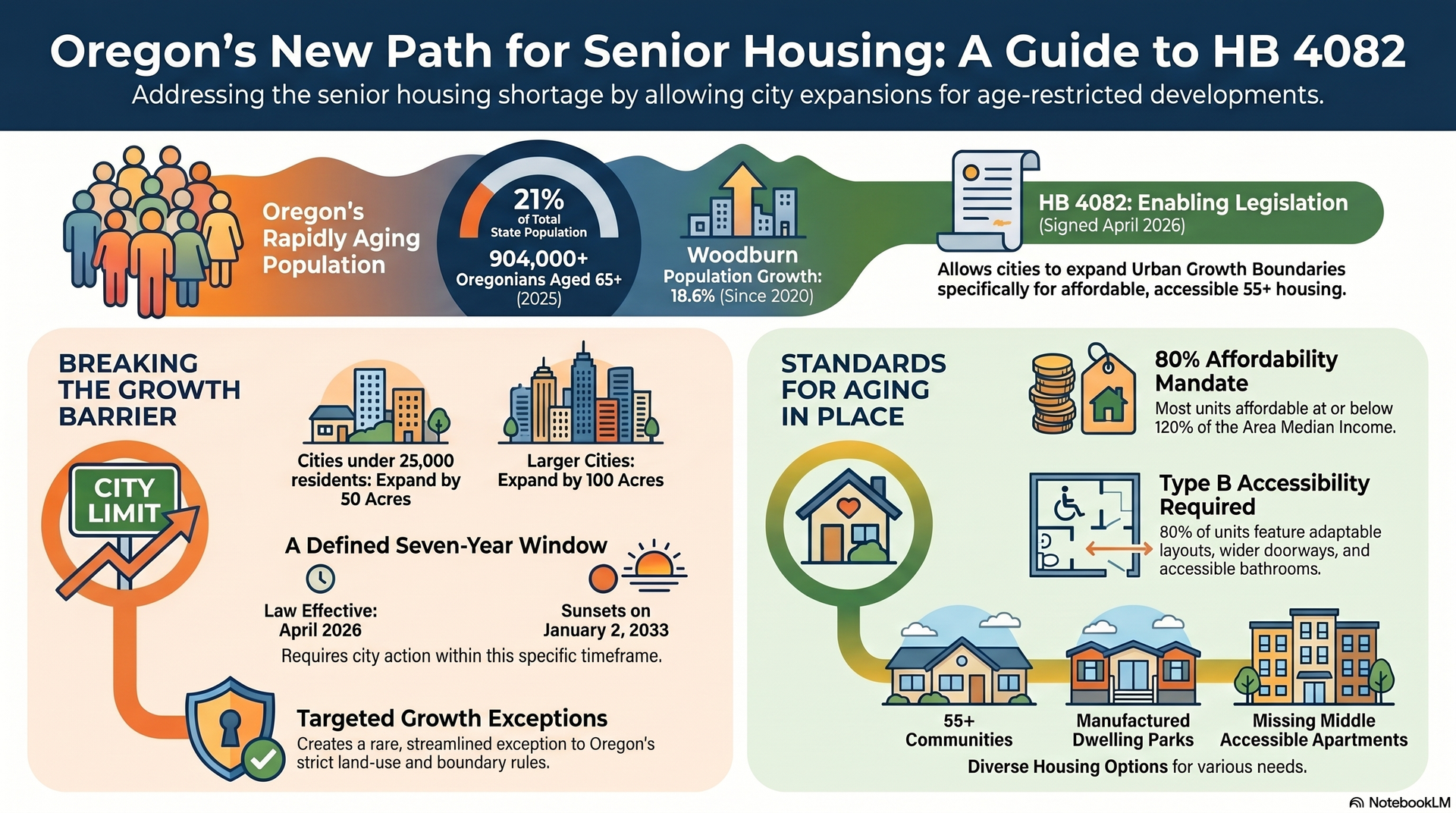
Oregon has an aging population and a housing market that hasn't kept pace with it. According to the Portland State University Population Research Center's 2025 Annual Population Report, more than 904,000 Oregonians — roughly 21% of the state's total population — were 65 or older as of July 1, 2025. (PSU publishes updated figures each July, so a new report is expected this summer.) The majority of those people want to stay in their communities as they age. But the supply of housing designed for that stage of life — accessible, appropriately sized, close to services — is limited across most of the state, and the Willamette Valley is no exception.
For families navigating a parent's move, or homeowners beginning to think seriously about their next chapter, this isn't an abstract policy problem. It's a practical one. The options that exist in your community right now determine what's actually possible.
That's what makes Oregon's new senior housing legislation worth understanding. It doesn't solve the shortage overnight — no single law does. But it opens a door that wasn't open before.
What Oregon Just Did About It
On April 22, 2026, Governor Tina Kotek signed House Bill 4082 at Woodburn City Hall — a deliberate choice of location, given Woodburn's position as one of the region's fastest-growing cities — population has climbed 18.6% since 2020, according to PSU — and its sizable senior community.
HB 4082 is enabling legislation. That's an important distinction. The law doesn't mandate that any city build senior housing, and it doesn't provide construction funding. What it does is give cities a new option they didn't have before: the ability to expand their urban growth boundaries specifically to accommodate 55+ housing and manufactured dwelling parks.
Before this law, expanding an urban growth boundary in Oregon was a lengthy, complex process subject to strict land-use rules. HB 4082 creates a targeted exception for senior housing, with specific parameters attached:
- Cities under 25,000 population can expand by up to 50 acres
- Cities 25,000 and above can expand by up to 100 acres
- All cities in Oregon are eligible — this isn't limited to high-growth metros
- 80% of non-manufactured units must be affordable at or below 120% of Area Median Income for at least 30 years
- 80% of units must meet Type B accessibility standards (wider doorways, accessible bathrooms, adaptable layouts)
- The law passed the House committee 13 to 0 — unusual unanimity for housing legislation
- It sunsets January 2, 2033 — cities have a defined window to act
- It takes effect 91 days after legislative adjournment — it is not yet in effect as of this writing
One additional note for Woodburn specifically: a companion bill, HB 4035, authorizes Woodburn's own 120-acre urban growth boundary expansion for senior housing — a larger allowance that reflects the city's particular circumstances and the fact that the signing ceremony was held there.
This is a real policy commitment. It's also the beginning of a process, not the end of one.
What This Means for the Willamette Valley Specifically
The Willamette Valley sits at the center of what this law is trying to address. Communities like Canby, Woodburn, Aurora, Hubbard, and Oregon City are exactly the kinds of mid-sized, established towns where seniors want to stay — close to family, familiar, connected — but where appropriately designed housing has historically been limited.
For these communities, HB 4082 creates a realistic pathway to growth that didn't exist before. Woodburn, with a 2025 population of 30,843, sits just above the 25,000 threshold in the law — which means it qualifies for the larger 100-acre urban growth boundary expansion. Combined with its companion bill HB 4035 authorizing a 120-acre expansion specifically for Woodburn, the city is already positioned to move quickly if developers and city planners align. Smaller cities under 25,000 — including most of the communities in the southern Willamette Valley — now have up to 50 acres of potential expansion specifically for this purpose.
The affordability and accessibility requirements built into the law matter for this region. Many Willamette Valley seniors are living on fixed incomes and don't need luxury housing — they need housing that's well-designed, accessible, and priced within reach. The 120% AMI affordability cap and Type B accessibility requirements aren't just regulatory checkboxes; they reflect what this population actually needs.
What's less certain is timeline and execution. HB 4082 gives cities the authority to act — it doesn't require them to act, fund the infrastructure, or guarantee that developers will respond. Cities still need to decide whether and how to use this tool, navigate their own planning processes, and attract investment. In some communities that will happen faster than others.
For families planning a transition in the next two to five years, this legislation is meaningful context — not a guarantee of specific options, but evidence that the gap between where seniors want to live and what's available is being taken seriously at the state level.
What "Housing for Older Persons" Actually Looks Like
One of the questions that comes up when people hear "senior housing legislation" is what kind of housing is actually being talked about. The answer is broader than most people expect.
Under HB 4082, qualifying development can take several forms:
55+ communities — age-restricted neighborhoods with single-family homes, attached townhomes, or small-lot cottages designed for residents at this life stage. These vary widely in price point, amenity level, and community feel. Some are active adult communities with clubhouses and social programming; others are quieter residential developments with the same layout benefits (single-level, accessible design, low-maintenance exteriors) without the resort-style overlay.
Manufactured dwelling parks — the law explicitly includes manufactured housing as a qualifying type, and this is worth naming directly. Manufactured homes on rented land in a well-managed park can represent one of the most affordable ownership pathways available to seniors on fixed incomes. Modern manufactured homes have changed substantially from the older stigma attached to the category — they can be well-built, energy-efficient, and designed with accessibility in mind. The inclusion of manufactured dwelling parks in this legislation reflects a realistic view of what affordability actually requires.
Accessible multifamily housing — smaller apartment and condominium developments meeting Type B accessibility standards. For seniors who don't want the maintenance of a single-family home and don't need or want the structure of assisted living, this category often represents the missing middle — and it's one of the least-supplied segments in most Willamette Valley markets.
What all of these share, under the new law, is a mandate for accessibility. Type B standards require features like accessible routes, maneuverable bathrooms, and adaptable design — housing that works for people as their needs change over time, not just at the moment of move-in.
What This Means If You're Thinking About Downsizing Now
If you're in the planning stages of a downsize — whether that's two years out or actively looking — HB 4082 is useful context, not a reason to wait.
Here's the practical reality: the housing this law enables won't be built overnight. Urban growth boundary expansions require planning processes, infrastructure studies, developer interest, and construction timelines. For most Willamette Valley communities, any new senior housing resulting from this legislation is realistically several years away from occupancy — if it materializes at all in a given city. (Oregon land use planning processes, infrastructure requirements, and construction timelines make this a multi-year undertaking at minimum; this reflects our professional read of the process, not a specific published estimate.)
What exists today is what you're working with in the near term. And the current inventory of age-appropriate housing in markets like Canby, Woodburn, and Oregon City is limited enough that being strategic and well-prepared matters more than waiting for future supply.
What this law does change is the longer-range picture. If you're helping an aging parent think through their options, or planning your own transition timeline, knowing that Oregon has created a policy pathway for more senior housing in your community is genuinely meaningful. It's reasonable to expect that the landscape of options will look different in five to seven years than it does today.
In the meantime, the most useful thing most families can do is start the conversation early — about what the right next home looks like, what budget is realistic, what tradeoffs matter, and what timeline makes sense given the specific property and life situation involved. If you're helping a parent navigate this process, our guide on how to help a parent sell their home without rushing walks through the timeline, the team you'll need, and how to keep the process from becoming more stressful than it has to be.
Frequently Asked Questions
Does HB 4082 mean new senior housing is coming to my city?
Not automatically. HB 4082 is enabling legislation — it gives cities the authority to expand their urban growth boundaries for senior housing, but it doesn't require them to act or provide funding for construction. Whether new housing gets built depends on each city's planning decisions and developer interest. The law creates the pathway; cities and developers have to choose to use it.
What does "Type B accessibility" mean for senior housing?
Type B is a federal accessibility standard under the Fair Housing Act that requires adaptable design features: accessible routes into and through the unit, maneuverable bathrooms, reinforced walls for future grab bar installation, and other elements that allow the home to accommodate changing mobility needs without major renovation. It's not the same as full wheelchair accessibility, but it's meaningfully better than standard residential construction for aging in place.
Is manufactured housing a real option for Oregon seniors?
Yes — and HB 4082 explicitly includes manufactured dwelling parks as a qualifying housing type. Modern manufactured homes are significantly different from older perceptions of the category and can represent an affordable, accessible ownership option for seniors on fixed incomes. As with any housing decision, the specific park's management, lot lease terms, and community feel matter considerably and are worth evaluating carefully.
If you're weighing your options in the Willamette Valley — whether that's timing a sale, figuring out what comes next, or sorting through what a parent's transition might look like — reach out for a local snapshot. No pressure, just real insights.
Ruth & Frank Howard, Brokers | Your Howard Team | Equity Oregon Real Estate
Serving Canby, Oregon City, Wilsonville, Woodburn, Aurora, Hubbard, and surrounding Willamette Valley communities.
yourhowardteam.com
Local market knowledge across the Willamette Valley — from Canby and Oregon City to Salem, Keizer, Woodburn, Hubbard, and surrounding areas.
 All information provided is deemed reliable but is not guaranteed and should be independently verified. IDX information is provided exclusively for consumers' personal, non-commercial use, that it may not be used for any purpose other than to identify prospective properties consumers may be interested in purchasing, and that the data is deemed reliable but is not guaranteed accurate by RMLSTM.
The content relating to real estate for sale on this web site comes in part from the IDX program of the RMLSTM of Portland, Oregon. Real estate listings held by brokerage firms other than Equity Oregon Real Estate are marked with the RMLSTM logo, and detailed information about these properties includes the names of the listing brokers. Listing content is copyright © 2026 RMLSTM, Portland, Oregon.
This content last updated on September 21, 2026 1:28 PM UTC at 4 AM. Some properties which appear for sale on this web site may subsequently have sold or may no longer be available.
All information provided is deemed reliable but is not guaranteed and should be independently verified. IDX information is provided exclusively for consumers' personal, non-commercial use, that it may not be used for any purpose other than to identify prospective properties consumers may be interested in purchasing, and that the data is deemed reliable but is not guaranteed accurate by RMLSTM.
The content relating to real estate for sale on this web site comes in part from the IDX program of the RMLSTM of Portland, Oregon. Real estate listings held by brokerage firms other than Equity Oregon Real Estate are marked with the RMLSTM logo, and detailed information about these properties includes the names of the listing brokers. Listing content is copyright © 2026 RMLSTM, Portland, Oregon.
This content last updated on September 21, 2026 1:28 PM UTC at 4 AM. Some properties which appear for sale on this web site may subsequently have sold or may no longer be available.
