

Why Buying a Home Still Pays Off in the Willamette Valley
Renting can feel less expensive and far simpler than buying a home. No repairs, no property taxes, no worrying about mortgage rates — you just pay the bill and move on with your life.
But here’s what people don’t talk about enough: renting doesn’t build your financial future. Homeowners, on the other hand, grow their net worth simply by owning a home. And across the Willamette Valley — from Canby and Oregon City to Salem, Keizer, Woodburn, Hubbard, and surrounding areas — that long-term advantage continues to hold true.
If you’ve been wondering whether buying is still worth it, the long-term math is clearer than most people realize.
Renting vs. Owning: How the Costs Really Compare
Here’s the key difference: when you rent, your payment goes to your landlord — and then it’s gone.
When you own, part of your payment comes back to you in the form of equity as:
- Your home value increases over time
- Your mortgage balance goes down
So even if renting feels more affordable today, it comes with a long-term cost: you’re not building wealth.
To dig deeper into this, First American analyzed the long-term financial impact of renting versus owning. They compared mortgage payments, property taxes, insurance, repairs, and maintenance against the equity gained through home price appreciation and paying down a mortgage. They ran the numbers during four distinct moments in the housing market:
- 2006 – the start of the housing bubble
- 2015 – a decade ago
- 2019 – just before the pandemic
- 2022 – when mortgage rates surged
Across every time frame, two things were consistent:
- Renters lost money over time.
- Homeowners gained it.
In other words, time in a home builds wealth. Time renting doesn’t.
Here’s how that looks over time for homeowners compared to renters.
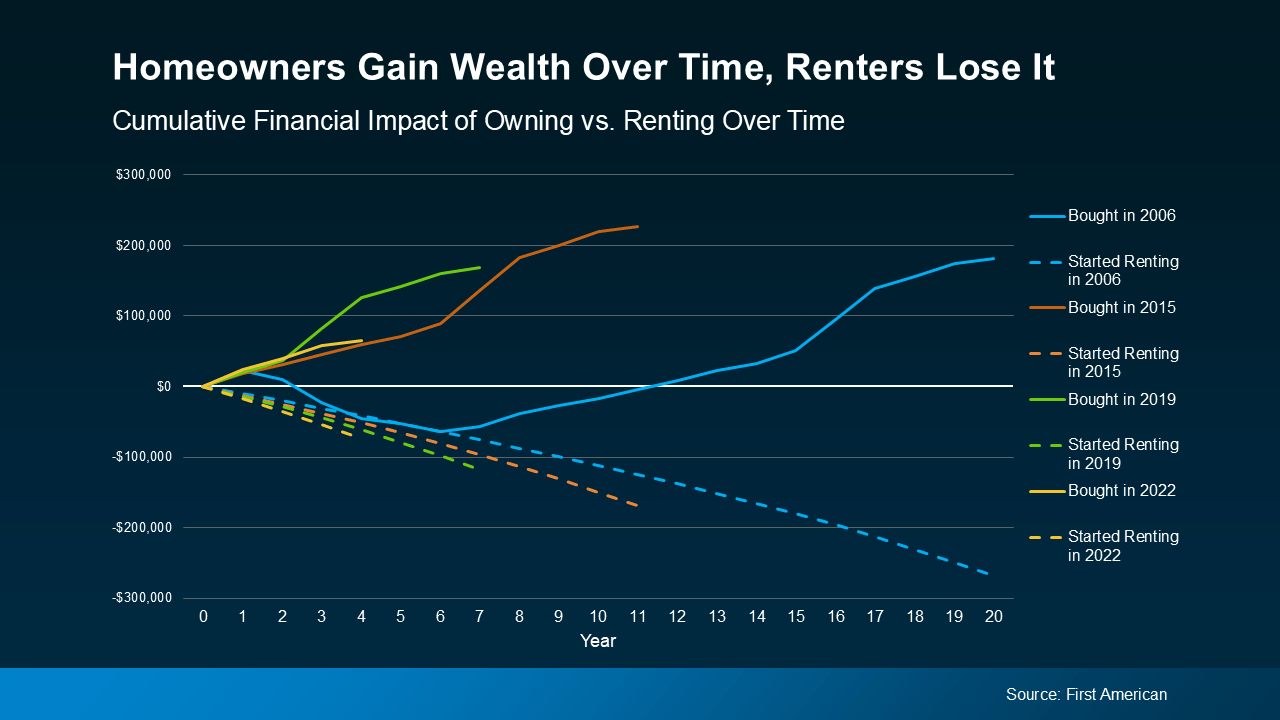
In the First American analysis, each color represents a different time frame. The solid lines (homeowners) show how net worth climbed the longer someone owned their home. The dashed line (renters) shows the opposite — money continually going out, with no long-term financial benefit.
The big takeaway is simple: time in a home builds wealth. Time renting doesn’t.
That pattern held true even after accounting for insurance, repairs, maintenance, and property taxes. Meanwhile, renters paid continuously without gaining any long-term return.
That doesn’t mean buying always beats renting in the short term. But the longer you own, the wider the wealth gap becomes.
Affordability Is Starting to Improve
You might still be thinking, “Buying feels out of reach right now.” That’s completely understandable.
The past few years have been challenging for buyers. But things are beginning to shift:
- Mortgage rates have eased from their peak
- Home prices are stabilizing in many areas
- Incomes have risen for many households
- Typical monthly payments are slightly easier than this time last year
Buying isn’t suddenly effortless, but the path is more accessible than it was just a few months ago. And history keeps showing the same pattern: over the long term, homeownership tends to pay off.
FAQ: Renting vs. Buying a Home
Q: Is buying a home still worth it if rent feels cheaper right now?
A: In many cases, yes. Rent may feel lower month-to-month, but those payments don’t build any equity or long-term wealth. When you own a home, part of your payment goes back into your pocket in the form of equity as the loan is paid down and the home appreciates over time.
Q: How long do I need to own a home before it usually pays off?
A: Every situation is different, but in general, the longer you own, the more the scales tip in your favor. That’s because more of your payment goes toward principal over time, and you benefit from years of potential price growth instead of helping your landlord build wealth.
Q: Don’t repairs, property taxes, and insurance cancel out the benefits of owning?
A: Those costs are real and should be part of your budget, but studies show that even after factoring in taxes, insurance, and maintenance, homeowners still tend to come out ahead over the long run. Equity growth and appreciation typically outpace those expenses, especially when you hold the home for several years.
Q: What if I’m not sure I’ll stay in the same area?
A: If you may need to move again soon, renting can sometimes make more sense in the short term. But if you see yourself staying in the Willamette Valley for a while and you’re ready to put down roots, it’s worth exploring what buying could look like for you so you can start building long-term wealth.
Bottom Line
Renting may feel cheaper today, but owning is what builds real, lasting wealth over time. And with affordability starting to improve, your pathway to homeownership may be opening up sooner than you expect.
If you’re exploring what buying a home could look like for you in the Willamette Valley, reach out anytime. No pressure, just real insights.
 All information provided is deemed reliable but is not guaranteed and should be independently verified. IDX information is provided exclusively for consumers' personal, non-commercial use, that it may not be used for any purpose other than to identify prospective properties consumers may be interested in purchasing, and that the data is deemed reliable but is not guaranteed accurate by RMLSTM.
The content relating to real estate for sale on this web site comes in part from the IDX program of the RMLSTM of Portland, Oregon. Real estate listings held by brokerage firms other than Equity Oregon Real Estate are marked with the RMLSTM logo, and detailed information about these properties includes the names of the listing brokers. Listing content is copyright © 2026 RMLSTM, Portland, Oregon.
This content last updated on September 21, 2026 1:28 PM UTC at 4 AM. Some properties which appear for sale on this web site may subsequently have sold or may no longer be available.
All information provided is deemed reliable but is not guaranteed and should be independently verified. IDX information is provided exclusively for consumers' personal, non-commercial use, that it may not be used for any purpose other than to identify prospective properties consumers may be interested in purchasing, and that the data is deemed reliable but is not guaranteed accurate by RMLSTM.
The content relating to real estate for sale on this web site comes in part from the IDX program of the RMLSTM of Portland, Oregon. Real estate listings held by brokerage firms other than Equity Oregon Real Estate are marked with the RMLSTM logo, and detailed information about these properties includes the names of the listing brokers. Listing content is copyright © 2026 RMLSTM, Portland, Oregon.
This content last updated on September 21, 2026 1:28 PM UTC at 4 AM. Some properties which appear for sale on this web site may subsequently have sold or may no longer be available.
